University of Michigan
ECON 401
Economics 401 Problem Set 9
Answer Key
Prof. David A. Miller
This version: October 28, 2020
1 Choice under uncertainty
1.1 Insurance
Consider a consumer with an income of 100, who faces an unavoidable risk of losing 75 with
probability 2%. Suppose the consumer has an expected utility preference, with the same state
utility function v(c)
...[Show More]
Economics 401 Problem Set 9
Answer Key
Prof. David A. Miller
This version: October 28, 2020
1 Choice under uncertainty
1.1 Insurance
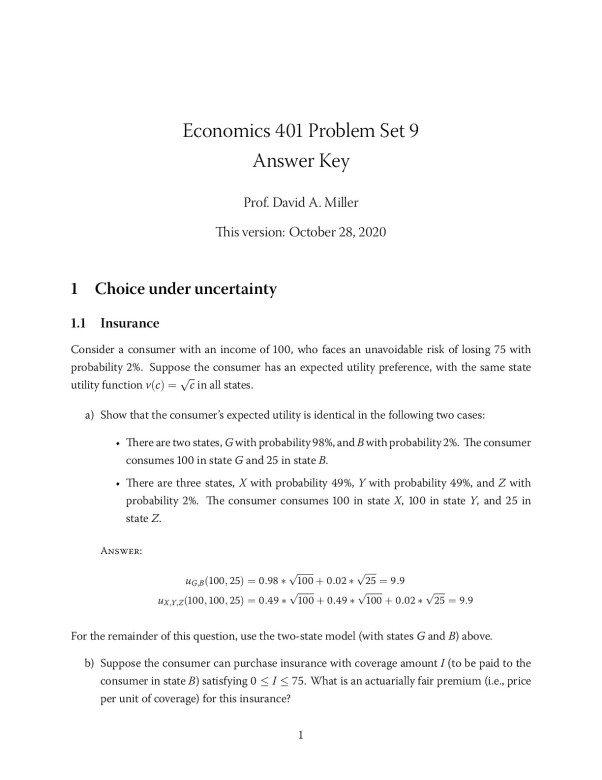
Consider a consumer with an income of 100, who faces an unavoidable risk of losing 75 with
probability 2%. Suppose the consumer has an expected utility preference, with the same state
utility function v(c) = √c in all states.
a) Show that the consumer’s expected utility is identical in the following two cases:
• There are two states, G with probability 98%, and B with probability 2%. The consumer
consumes 100 in state G and 25 in state B.
• There are three states, X with probability 49%, Y with probability 49%, and Z with
probability 2%. The consumer consumes 100 in state X, 100 in state Y, and 25 in
state Z.
Answer:
uG,B(100, 25) = 0.98 ∗ √100 + 0.02 ∗ √25 = 9.9
uX,Y,Z(100, 100, 25) = 0.49 ∗ √100 + 0.49 ∗ √100 + 0.02 ∗ √25 = 9.9
For the remainder of this question, use the two-state model (with states G and B) above.
b) Suppose the consumer can purchase insurance with coverage amount I (to be paid to the
consumer in state B) satisfying 0 ≤ I ≤ 75. What is an actuarially fair premium (i.e., price
per unit of coverage) for this insurance?
[Show Less]