Imus Institute College
BUSINESS M 202
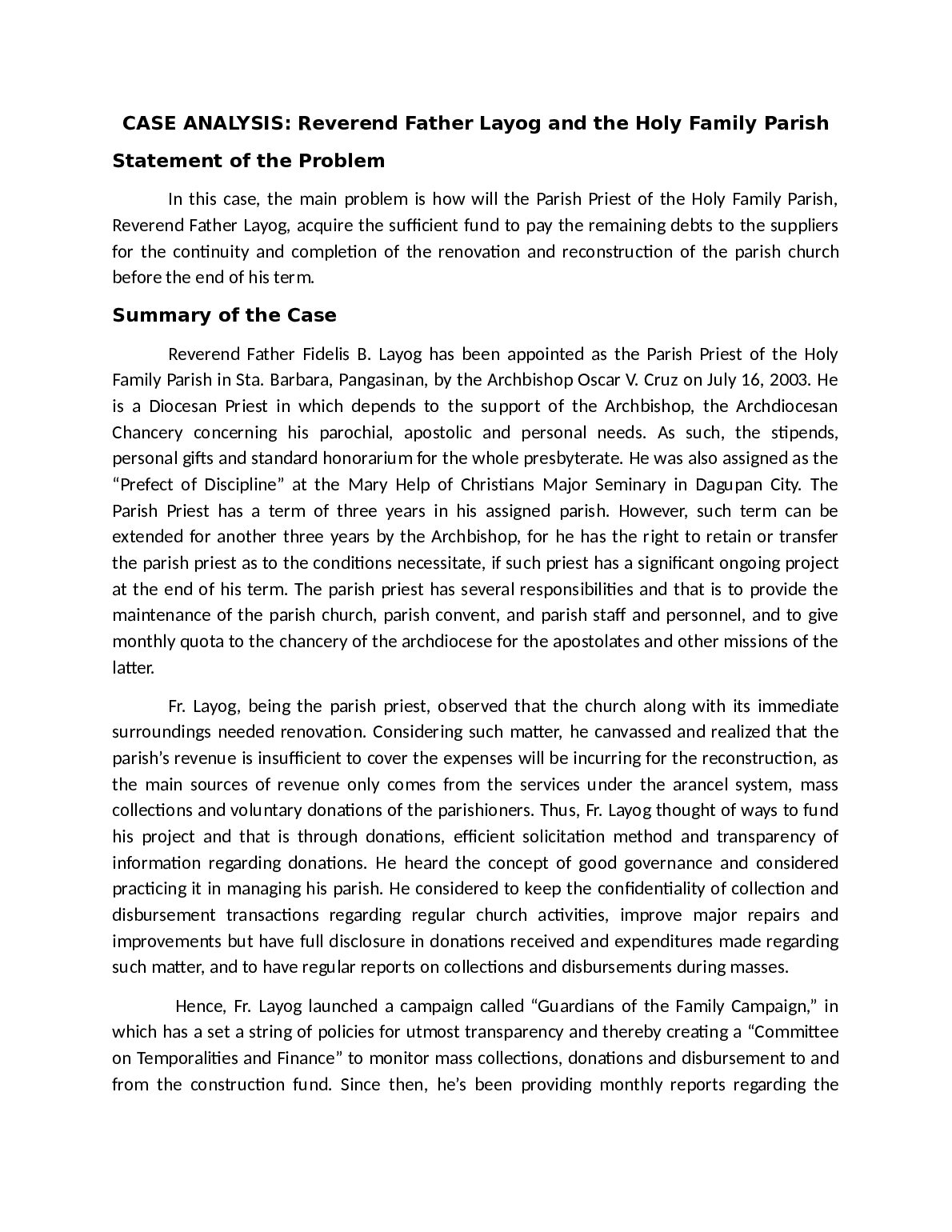
CASE ANALYSIS: Reverend Father Layog and the Holy Family Parish
Statement of the Problem
In this case, the main problem is how will the Parish Priest of the Holy Family Parish,
Reverend Father Layog, acquire the sufficient fund to pay the remaining debts to the suppliers
for the continuity and completion of the renovation and
...[Show More]
CASE ANALYSIS: Reverend Father Layog and the Holy Family Parish
Statement of the Problem
In this case, the main problem is how will the Parish Priest of the Holy Family Parish,
Reverend Father Layog, acquire the sufficient fund to pay the remaining debts to the suppliers
for the continuity and completion of the renovation and reconstruction of the parish church
before the end of his term.
Summary of the Case
Reverend Father Fidelis B. Layog has been appointed as the Parish Priest of the Holy
Family Parish in Sta. Barbara, Pangasinan, by the Archbishop Oscar V. Cruz on July 16, 2003. He
is a Diocesan Priest in which depends to the support of the Archbishop, the Archdiocesan
Chancery concerning his parochial, apostolic and personal needs. As such, the stipends,
personal gifts and standard honorarium for the whole presbyterate. He was also assigned as the
“Prefect of Discipline” at the Mary Help of Christians Major Seminary in Dagupan City. The
Parish Priest has a term of three years in his assigned parish. However, such term can be
extended for another three years by the Archbishop, for he has the right to retain or transfer
the parish priest as to the conditions necessitate, if such priest has a significant ongoing project
at the end of his term. The parish priest has several responsibilities and that is to provide the
maintenance of the parish church, parish convent, and parish staff and personnel, and to give
monthly quota to the chancery of the archdiocese for the apostolates and other missions of the
latter.
Fr. Layog, being the parish priest, observed that the church along with its immediate
surroundings needed renovation. Considering such matter, he canvassed and realized that the
parish’s revenue is insufficient to cover the expenses will be incurring for the reconstruction, as
the main sources of revenue only comes from the services under the arancel system, mass
collections and voluntary donations of the parishioners. Thus, Fr. Layog thought of ways to fund
his project and that is through donations, efficient solicitation method and transparency of
information regarding donations. He heard the concept of good governance and considered
practicing it in managing his parish. He considered to keep the confidentiality of collection and
disbursement transactions regarding regular church activities, improve major repairs and
improvements but have full disclosure in donations received and expenditures made regarding
such matter, and to have regular reports on collections and disbursements during masses.
Hence, Fr. Layog launched a campaign called “Guardians of the Family Campaign,” in
which has a set a string of policies for utmost transparency and thereby creating a “Committee
on Temporalities and Finance” to monitor mass collections, donations and disbursement to and
from the construction fund. Since then, he’s been providing monthly reports regarding the
[Show Less]