Touro University Worldwide
MFT 618
Case Assignment: MFT 618 Group Counseling
Group Counseling Case Study
Touro University Worldwide
March 27, 2021
2
Introduction
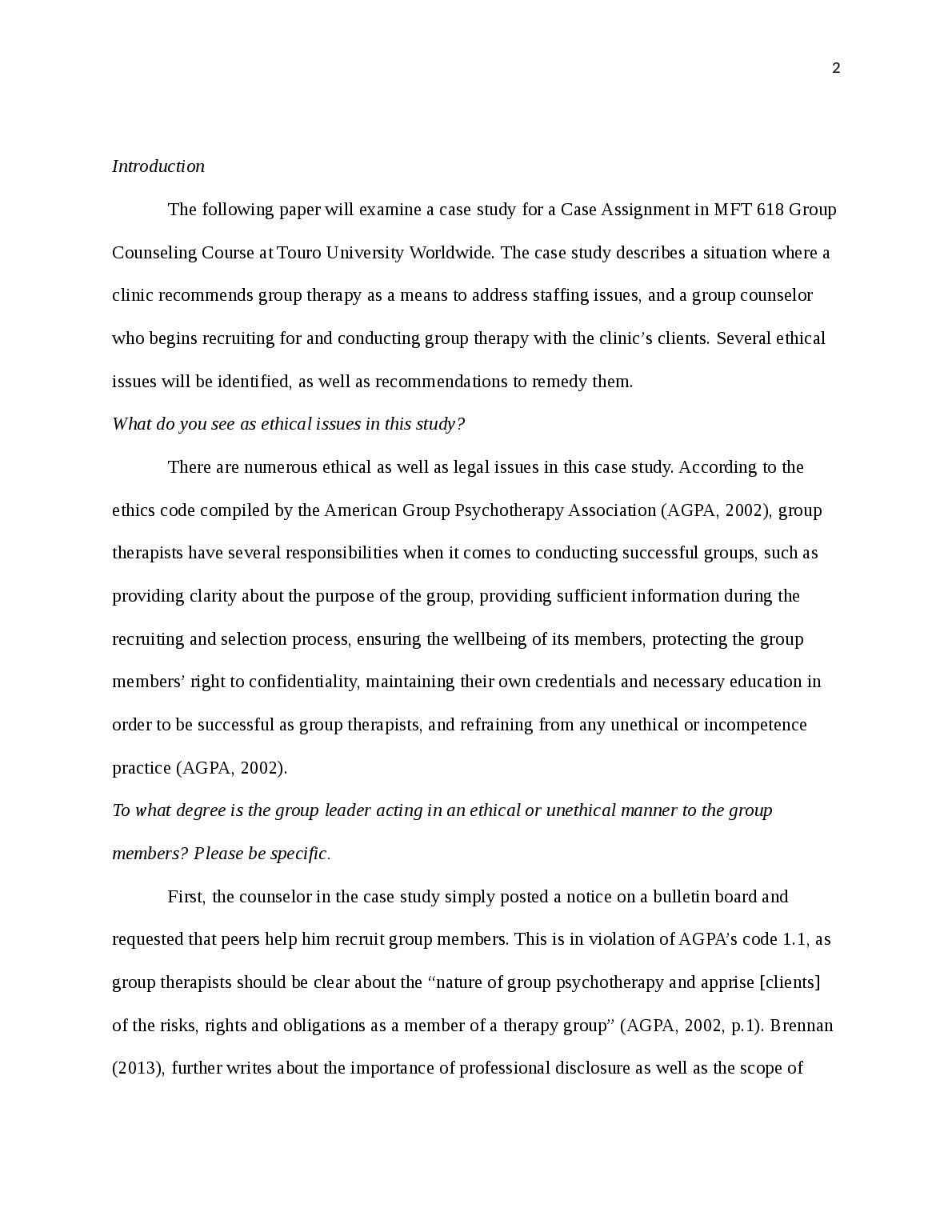
The following paper will examine a case study for a Case Assignment in MFT 618 Group
Counseling Course at Touro University Worldwide. The case study describes a situation where a
clinic
...[Show More]
Case Assignment: MFT 618 Group Counseling
Group Counseling Case Study
Touro University Worldwide
March 27, 2021
2
Introduction
The following paper will examine a case study for a Case Assignment in MFT 618 Group
Counseling Course at Touro University Worldwide. The case study describes a situation where a
clinic recommends group therapy as a means to address staffing issues, and a group counselor
who begins recruiting for and conducting group therapy with the clinic’s clients. Several ethical
issues will be identified, as well as recommendations to remedy them.
What do you see as ethical issues in this study?
There are numerous ethical as well as legal issues in this case study. According to the
ethics code compiled by the American Group Psychotherapy Association (AGPA, 2002), group
therapists have several responsibilities when it comes to conducting successful groups, such as
providing clarity about the purpose of the group, providing sufficient information during the
recruiting and selection process, ensuring the wellbeing of its members, protecting the group
members’ right to confidentiality, maintaining their own credentials and necessary education in
order to be successful as group therapists, and refraining from any unethical or incompetence
practice (AGPA, 2002).
To what degree is the group leader acting in an ethical or unethical manner to the group
members? Please be specific.
First, the counselor in the case study simply posted a notice on a bulletin board and
requested that peers help him recruit group members. This is in violation of AGPA’s code 1.1, as
group therapists should be clear about the “nature of group psychotherapy and apprise [clients]
of the risks, rights and obligations as a member of a therapy group” (AGPA, 2002, p.1). Brennan
(2013), further writes about the importance of professional disclosure as well as the scope of
3
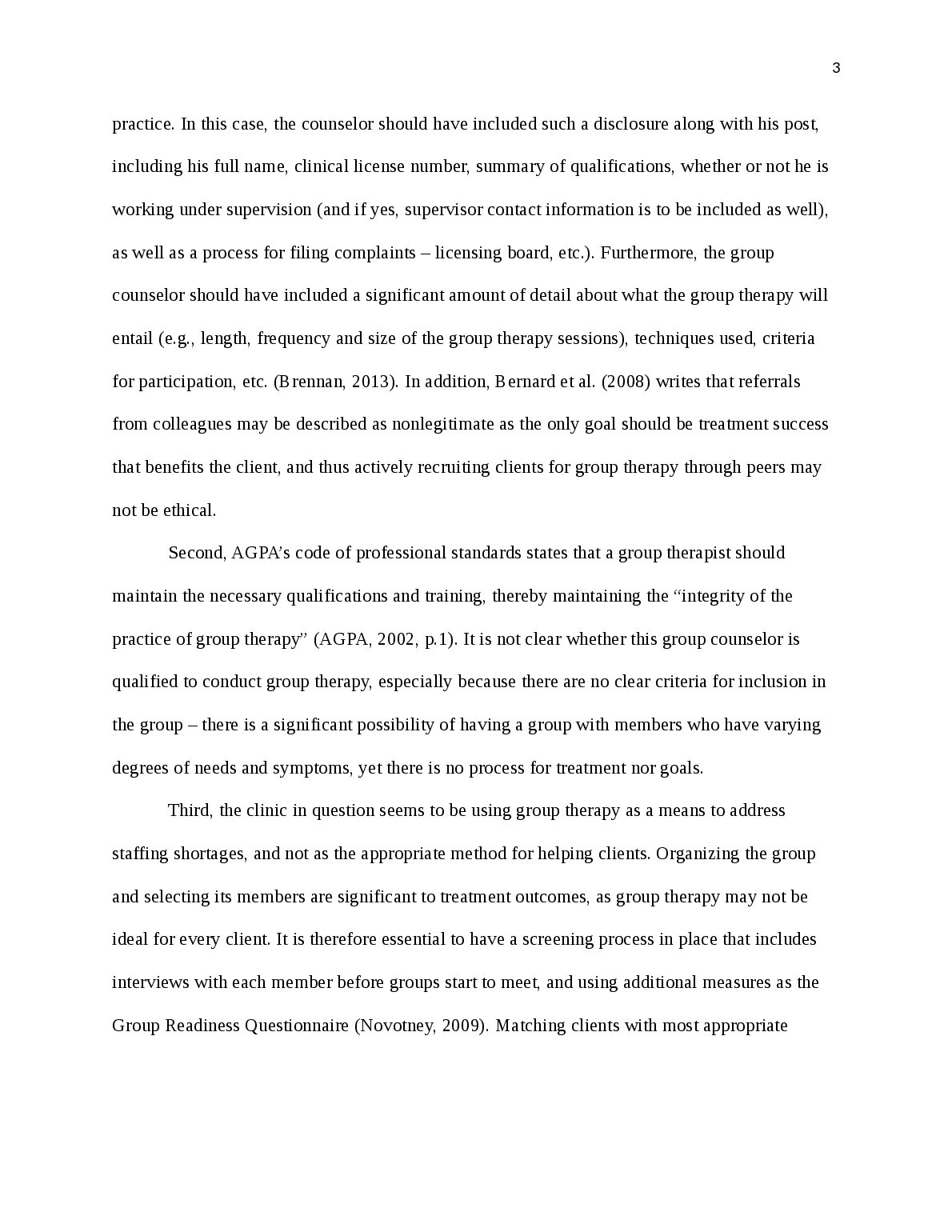
practice. In this case, the counselor should have included such a disclosure along with his post,
including his full name, clinical license number, summary of qualifications, whether or not he is
working under supervision (and if yes, supervisor contact information is to be included as well),
as well as a process for filing complaints – licensing board, etc.). Furthermore, the group
counselor should have included a significant amount of detail about what the group therapy will
entail (e.g., length, frequency and size of the group therapy sessions), techniques used, criteria
for participation, etc. (Brennan, 2013). In addition, Bernard et al. (2008) writes that referrals
from colleagues may be described as nonlegitimate as the only goal should be treatment success
that benefits the client, and thus actively recruiting clients for group therapy through peers may
not be ethical.
Second, AGPA’s code of professional standards states that a group therapist should
maintain the necessary qualifications and training, thereby maintaining the “integrity of the
practice of group therapy” (AGPA, 2002, p.1). It is not clear whether this group counselor is
qualified to conduct group therapy, especially because there are no clear criteria for inclusion in
the group – there is a significant possibility of having a group with members who have varying
degrees of needs and symptoms, yet there is no process for treatment nor goals.
Third, the clinic in question seems to be using group therapy as a means to address
staffing shortages, and not as the appropriate method for helping clients. Organizing the group
and selecting its members are significant to treatment outcomes, as group therapy may not be
ideal for every client. It is therefore essential to have a screening process in place that includes
interviews with each member before groups start to meet, and using additional measures as the
Group Readiness Questionnaire (Novotney, 2009). Matching clients with most appropriate
[Show Less]