Isabela state university-cauayan campus
CBM N/A
MICROECONOMICS
CHAPTER I : INTRODUCTION TO ECONOMICS AND ECONOMY
THE NATURE AND METHOD OF ECONOMICS
The nature of economics
Economics is the social science that studies the production, distribution, and consumption of goods and services. It
examines how individuals, businesses, and governments make decisions about
...[Show More]
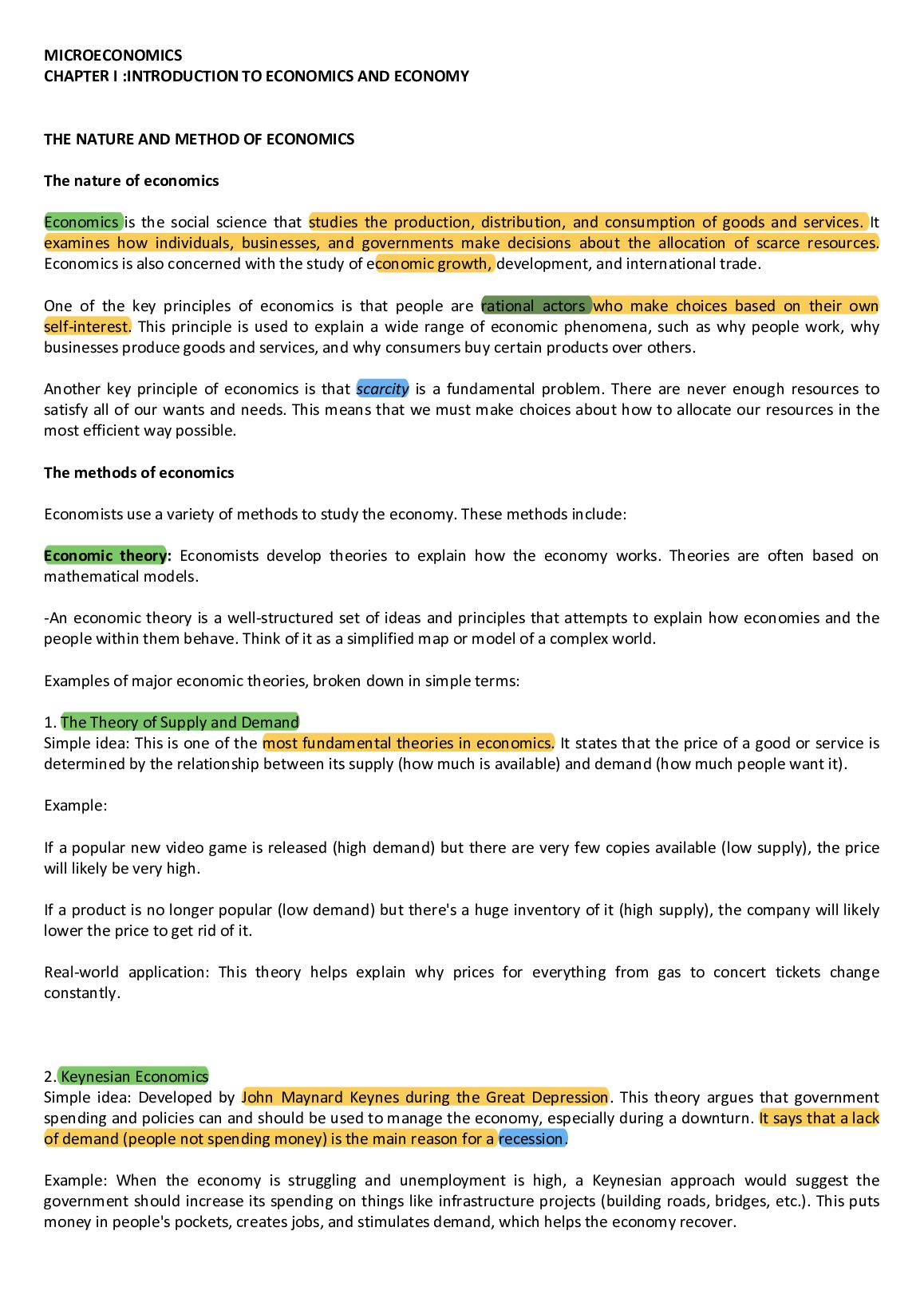
MICROECONOMICS
CHAPTER I : INTRODUCTION TO ECONOMICS AND ECONOMY
THE NATURE AND METHOD OF ECONOMICS
The nature of economics
Economics is the social science that studies the production, distribution, and consumption of goods and services. It
examines how individuals, businesses, and governments make decisions about the allocation of scarce resources.
Economics is also concerned with the study of economic growth, development, and international trade.
One of the key principles of economics is that people are rational actors who make choices based on their own
self-interest. This principle is used to explain a wide range of economic phenomena, such as why people work, why
businesses produce goods and services, and why consumers buy certain products over others.
Another key principle of economics is that scarcity is a fundamental problem. There are never enough resources to
satisfy all of our wants and needs. This means that we must make choices about how to allocate our resources in the
most efficient way possible.
The methods of economics
Economists use a variety of methods to study the economy. These methods include:
Economic theory: Economists develop theories to explain how the economy works. Theories are often based on
mathematical models.
-An economic theory is a well-structured set of ideas and principles that attempts to explain how economies and the
people within them behave. Think of it as a simplified map or model of a complex world.
Examples of major economic theories, broken down in simple terms:
1. The Theory of Supply and Demand
Simple idea: This is one of the most fundamental theories in economics. It states that the price of a good or service is
determined by the relationship between its supply (how much is available) and demand (how much people want it).
Example:
If a popular new video game is released (high demand) but there are very few copies available (low supply), the price
will likely be very high.
If a product is no longer popular (low demand) but there's a huge inventory of it (high supply), the company will likely
lower the price to get rid of it.
Real-world application: This theory helps explain why prices for everything from gas to concert tickets change
constantly.
2. Keynesian Economics
Simple idea: Developed by John Maynard Keynes during the Great Depression. This theory argues that government
spending and policies can and should be used to manage the economy, especially during a downturn. It says that a lack
of demand (people not spending money) is the main reason for a recession.
Example: When the economy is struggling and unemployment is high, a Keynesian approach would suggest the
government should increase its spending on things like infrastructure projects (building roads, bridges, etc.). This puts
money in people's pockets, creates jobs, and stimulates demand, which helps the economy recover.
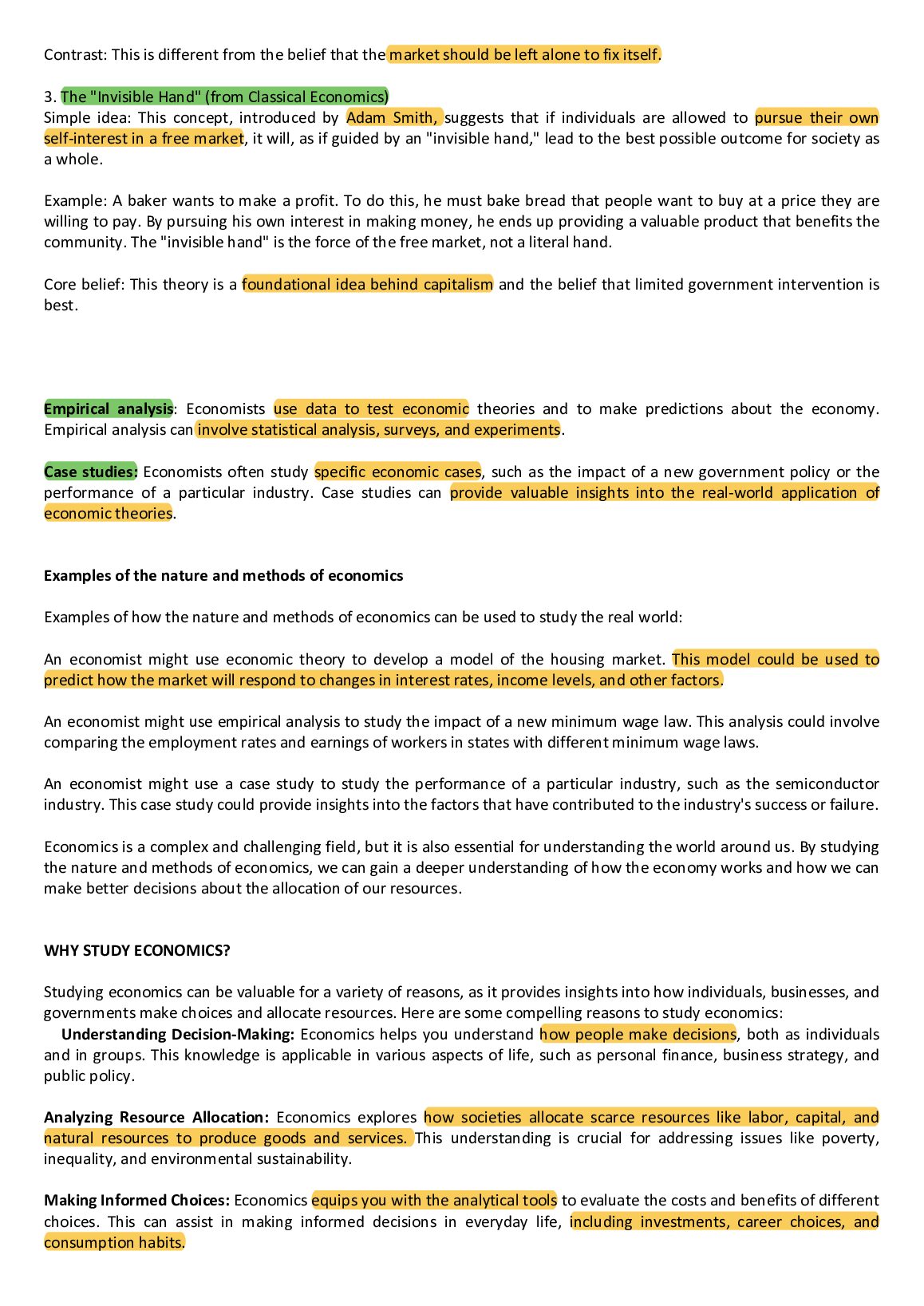
Contrast: This is different from the belief that the market should be left alone to fix itself.
3. The "Invisible Hand" (from Classical Economics)
Simple idea: This concept, introduced by Adam Smith, suggests that if individuals are allowed to pursue their own
self-interest in a free market, it will, as if guided by an "invisible hand," lead to the best possible outcome for society as
a whole.
Example: A baker wants to make a profit. To do this, he must bake bread that people want to buy at a price they are
willing to pay. By pursuing his own interest in making money, he ends up providing a valuable product that benefits the
community. The "invisible hand" is the force of the free market, not a literal hand.
Core belief: This theory is a foundational idea behind capitalism and the belief that limited government intervention is
best.
Empirical analysis: Economists use data to test economic theories and to make predictions about the economy.
Empirical analysis can involve statistical analysis, surveys, and experiments.
Case studies: Economists often study specific economic cases, such as the impact of a new government policy or the
performance of a particular industry. Case studies can provide valuable insights into the real-world application of
economic theories.
Examples of the nature and methods of economics
Examples of how the nature and methods of economics can be used to study the real world:
An economist might use economic theory to develop a model of the housing market. This model could be used to
predict how the market will respond to changes in interest rates, income levels, and other factors.
An economist might use empirical analysis to study the impact of a new minimum wage law. This analysis could involve
comparing the employment rates and earnings of workers in states with different minimum wage laws.
An economist might use a case study to study the performance of a particular industry, such as the semiconductor
industry. This case study could provide insights into the factors that have contributed to the industry's success or failure.
Economics is a complex and challenging field, but it is also essential for understanding the world around us. By studying
the nature and methods of economics, we can gain a deeper understanding of how the economy works and how we can
make better decisions about the allocation of our resources.
WHY STUDY ECONOMICS?
Studying economics can be valuable for a variety of reasons, as it provides insights into how individuals, businesses, and
governments make choices and allocate resources. Here are some compelling reasons to study economics:
Understanding Decision-Making: Economics helps you understand how people make decisions, both as individuals
and in groups. This knowledge is applicable in various aspects of life, such as personal finance, business strategy, and
public policy.
Analyzing Resource Allocation: Economics explores how societies allocate scarce resources like labor, capital, and
natural resources to produce goods and services. This understanding is crucial for addressing issues like poverty,
inequality, and environmental sustainability.
Making Informed Choices: Economics equips you with the analytical tools to evaluate the costs and benefits of different
choices. This can assist in making informed decisions in everyday life, including investments, career choices, and
consumption habits.
[Show Less]