British Columbia Institute of Technology
BSNC 6000
The central nervous system (CNS) consists of the brain and the spinal cord, which are protected by the skull and vertebral column. The
CNS gathers information about the environment from the peripheral nervous system (PNS), processes this information, perceives part
of it, and organizes reflexes and other behavioral resp
...[Show More]
The central nervous system (CNS) consists of the brain and the spinal cord, which are protected by the skull and vertebral column. The
CNS gathers information about the environment from the peripheral nervous system (PNS), processes this information, perceives part
of it, and organizes reflexes and other behavioral responses. CNS regulation refers to the mechanisms or conditions that impact CNS
processing and functioning.
For the CNS to function optimally, there must be a consistent supply of blood, delivering oxygen and nutrients. CNS perfusion can be
disrupted in a number of different conditions such as internal blockage of a vessel, severe hypotension, or loss of vessel integrity
attributable to damage or excessive external pressure on a vessel that exceeds perfusion pressure. For example, an ischemic stroke is the
result of inadequate perfusion past the thrombus or embolus. Perfusion can also be disrupted as the result of an intracranial hemorrhage,
such as a subdural hematoma or subarachnoid hemorrhage caused by a traumatic brain injury (TBI). A disruption of cerebral perfusion
leads to a wide variety of problems, depending on the area of the CNS that is affected and the length of time before perfusion is restored.
Optimal functioning of the CNS is dependent on the transmission of nerve impulses across neuronal synapses by neurotransmitters.
Normal transmission requires fully functioning neurons, nerves, and neurotransmitters. Neurotransmitters can be either excitatory or
inhibitory.
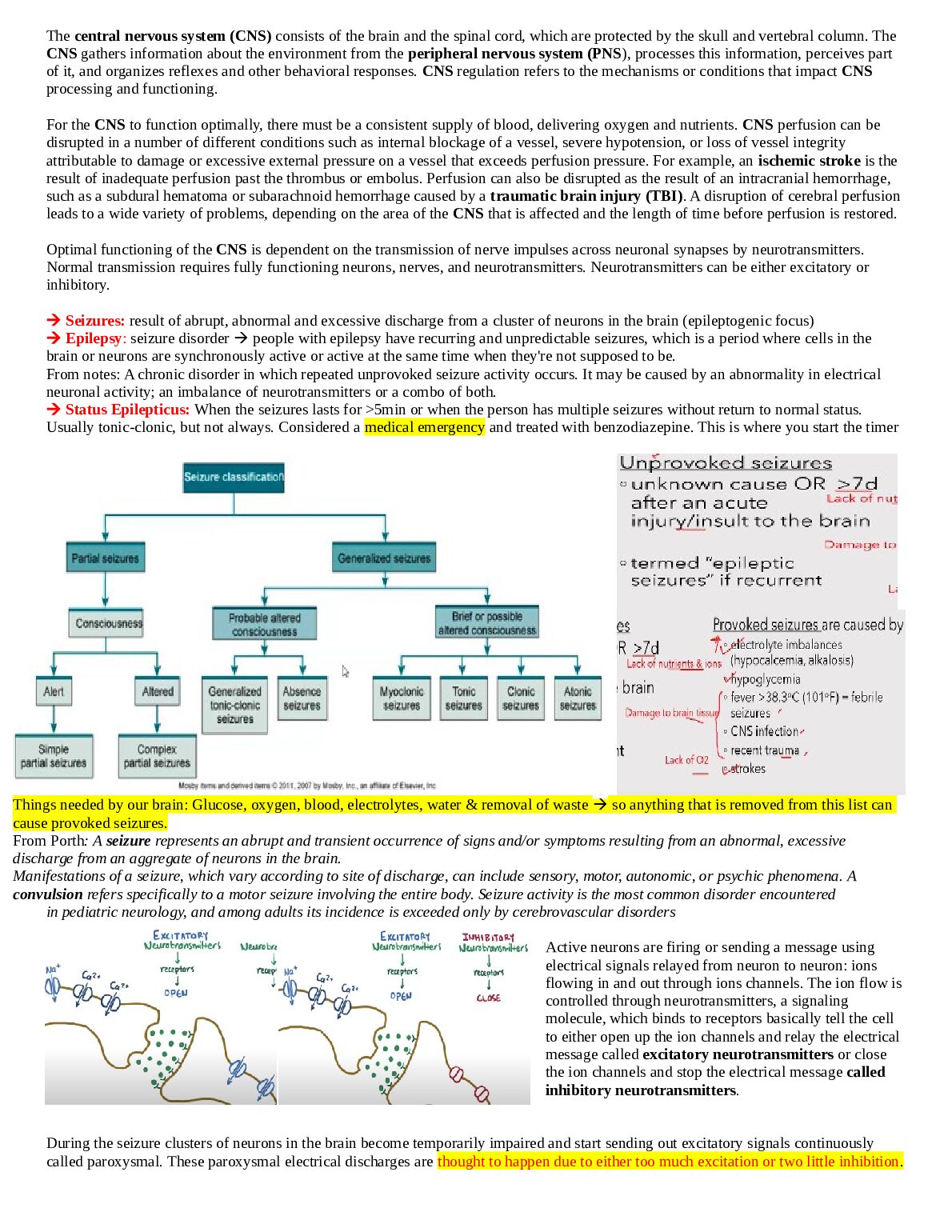
à Seizures: result of abrupt, abnormal and excessive discharge from a cluster of neurons in the brain (epileptogenic focus)
à Epilepsy: seizure disorder à people with epilepsy have recurring and unpredictable seizures, which is a period where cells in the
brain or neurons are synchronously active or active at the same time when they're not supposed to be.
From notes: A chronic disorder in which repeated unprovoked seizure activity occurs. It may be caused by an abnormality in electrical
neuronal activity; an imbalance of neurotransmitters or a combo of both.
à Status Epilepticus: When the seizures lasts for >5min or when the person has multiple seizures without return to normal status.
Usually tonic-clonic, but not always. Considered a medical emergency and treated with benzodiazepine. This is where you start the timer
Things needed by our brain: Glucose, oxygen, blood, electrolytes, water & removal of waste à so anything that is removed from this list can
cause provoked seizures.
From Porth: A seizure represents an abrupt and transient occurrence of signs and/or symptoms resulting from an abnormal, excessive
discharge from an aggregate of neurons in the brain.
Manifestations of a seizure, which vary according to site of discharge, can include sensory, motor, autonomic, or psychic phenomena. A
convulsion refers specifically to a motor seizure involving the entire body. Seizure activity is the most common disorder encountered
in pediatric neurology, and among adults its incidence is exceeded only by cerebrovascular disorders
Active neurons are firing or sending a message using
electrical signals relayed from neuron to neuron: ions
flowing in and out through ions channels. The ion flow is
controlled through neurotransmitters, a signaling
molecule, which binds to receptors basically tell the cell
to either open up the ion channels and relay the electrical
message called excitatory neurotransmitters or close
the ion channels and stop the electrical message called
inhibitory neurotransmitters.
During the seizure clusters of neurons in the brain become temporarily impaired and start sending out excitatory signals continuously
called paroxysmal. These paroxysmal electrical discharges are thought to happen due to either too much excitation or two little inhibition.
The main excitatory neurotransmitter in the brain is glutamate is
the primary receptor that responds to glutamate by opening ion
channels that let Ca2+, which communicate to cells to send signals.
Some patients with epilepsy seem to have faster long-lasting
activation of these receptors.
The main inhibitory neurotransmitter in the brain is GABA which
binds to its receptors to inhibit the signal by opening channels that
lead in Cl- ions that tell the cell to inhibit signals. Some patients with
epilepsy have genetic mutations or other cause in which their GABA
receptors are dysfunctional and so they aren't able to inhibit signals.
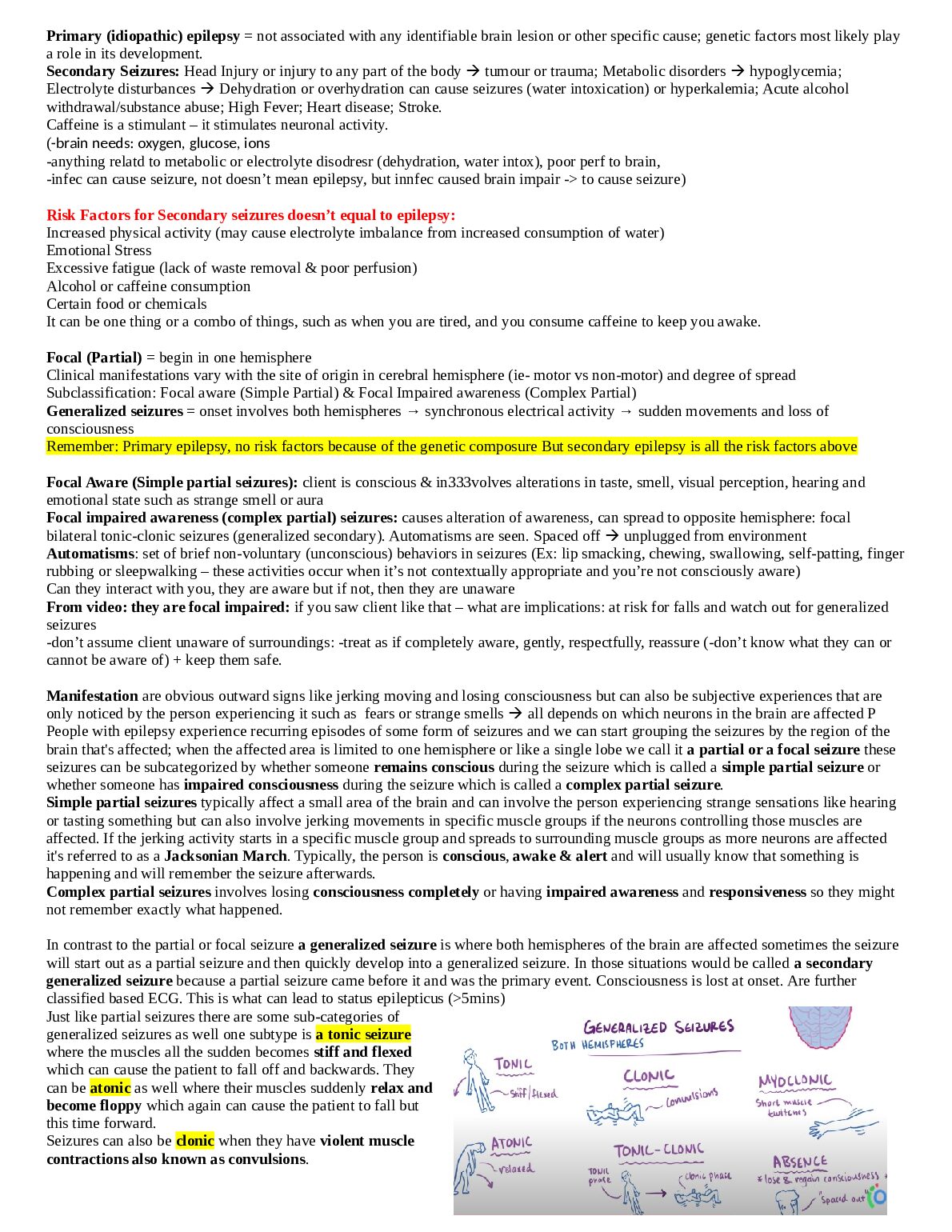
Seizures can be caused due to either too much excitation or two little inhibition or because there is some disengagement between the
somatosensory cortex and motor cortex or from motor cortex going down to the spinal cord. The disengagement could be anywhere.
We could have seizures that is pure sensory in which the brain is getting all this info that is not there. For instance, people get toast smell,
even when there is no toast because there is abnormal firing (epileptogenic focus) at the part of the brain that focusses on toast smell. A
sensation has got to the motor control or any kind of sensation in the body that causes epileptogenic focu
Take-home message: For seizures activities to happen it depends on where the abnormal focus (epileptogenic focus) is whether it's a
sensory or motor area and any type of stress to the brain can cause an abnormal shortcut (sometimes because an area of the brain lacks
oxygen) therefore bypassing this voluntary control or you just have an abnormal imbalance of glutamate to GABA activation.
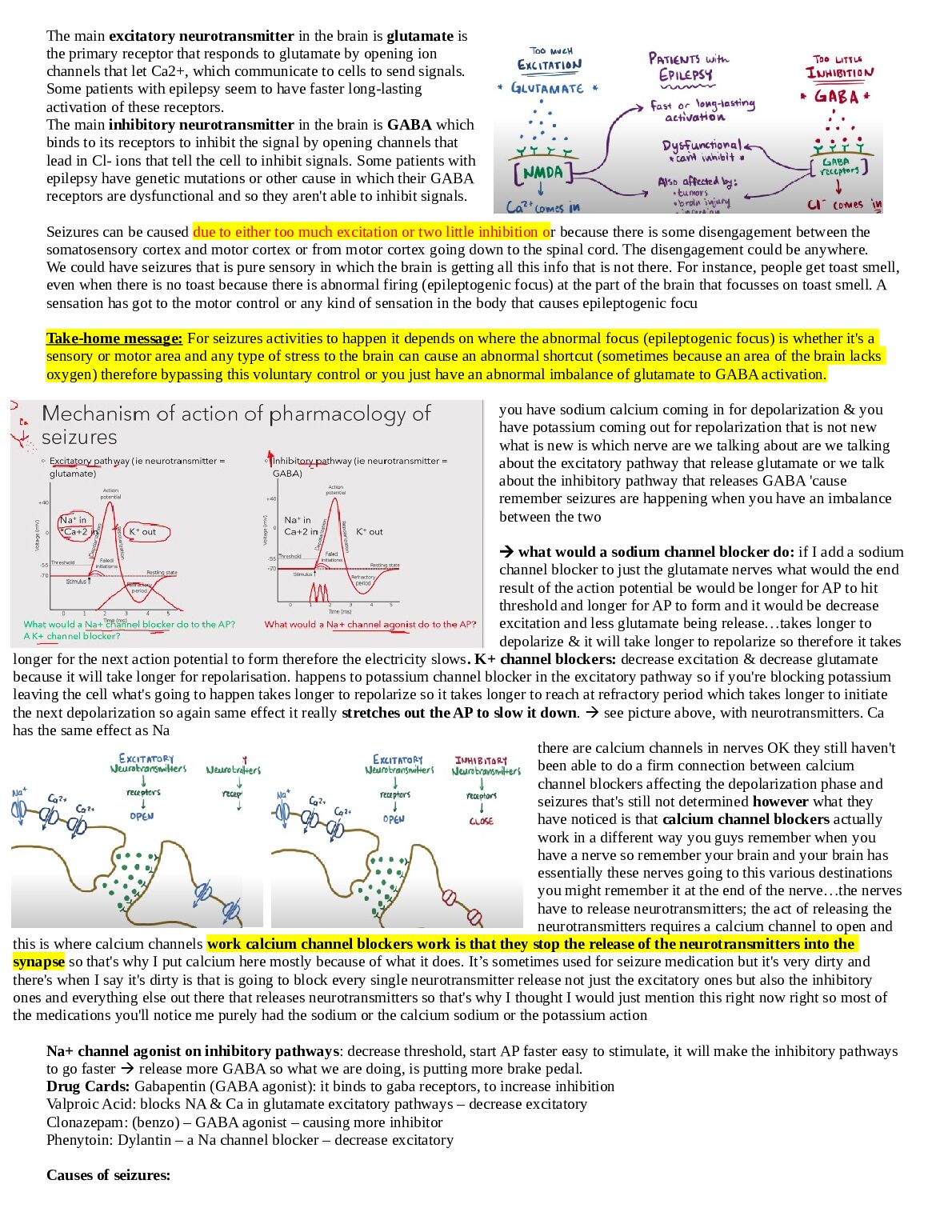
you have sodium calcium coming in for depolarization & you
have potassium coming out for repolarization that is not new
what is new is which nerve are we talking about are we talking
about the excitatory pathway that release glutamate or we talk
about the inhibitory pathway that releases GABA 'cause
remember seizures are happening when you have an imbalance
between the two
à what would a sodium channel blocker do: if I add a sodium
channel blocker to just the glutamate nerves what would the end
result of the action potential be would be longer for AP to hit
threshold and longer for AP to form and it would be decrease
excitation and less glutamate being release…takes longer to
depolarize & it will take longer to repolarize so therefore it takes
longer for the next action potential to form therefore the electricity slows. K+ channel blockers: decrease excitation & decrease glutamate
because it will take longer for repolarisation. happens to potassium channel blocker in the excitatory pathway so if you're blocking potassium
leaving the cell what's going to happen takes longer to repolarize so it takes longer to reach at refractory period which takes longer to initiate
the next depolarization so again same effect it really stretches out the AP to slow it down. à see picture above, with neurotransmitters. Ca
has the same effect as Na
there are calcium channels in nerves OK they still haven't
been able to do a firm connection between calcium
channel blockers affecting the depolarization phase and
seizures that's still not determined however what they
have noticed is that calcium channel blockers actually
work in a different way you guys remember when you
have a nerve so remember your brain and your brain has
essentially these nerves going to this various destinations
you might remember it at the end of the nerve…the nerves
have to release neurotransmitters; the act of releasing the
neurotransmitters requires a calcium channel to open and
this is where calcium channels work calcium channel blockers work is that they stop the release of the neurotransmitters into the
synapse so that's why I put calcium here mostly because of what it does. It’s sometimes used for seizure medication but it's very dirty and
there's when I say it's dirty is that is going to block every single neurotransmitter release not just the excitatory ones but also the inhibitory
ones and everything else out there that releases neurotransmitters so that's why I thought I would just mention this right now right so most of
the medications you'll notice me purely had the sodium or the calcium sodium or the potassium action
Na+ channel agonist on inhibitory pathways: decrease threshold, start AP faster easy to stimulate, it will make the inhibitory pathways
to go faster à release more GABA so what we are doing, is putting more brake pedal.
Drug Cards: Gabapentin (GABA agonist): it binds to gaba receptors, to increase inhibition
Valproic Acid: blocks NA & Ca in glutamate excitatory pathways – decrease excitatory
Clonazepam: (benzo) – GABA agonist – causing more inhibitor
Phenytoin: Dylantin – a Na channel blocker – decrease excitat
[Show Less]