Stony Brook University
CHE 301
CHE301 EXAM 1
QUESTION 1: This includes the first law of thermodynamics; definitions of different types of
systems/processes (e.g., isothermal, adiabatic, etc.); state variables.
First Law of Thermodynamics: energy is conserved; cannot be created or destroyed, but can be
transferred and change forms. Total energy is constant.
Syst
...[Show More]
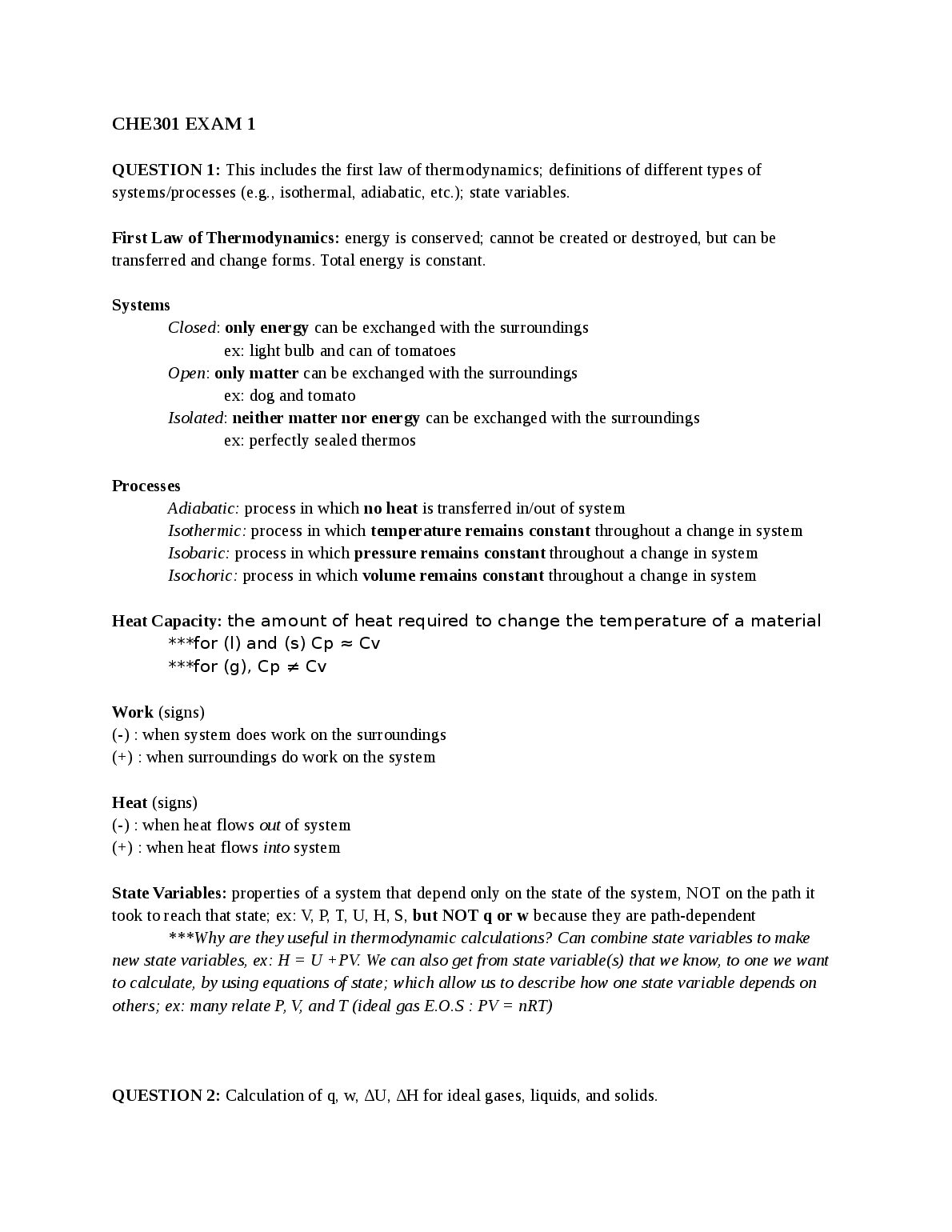
CHE301 EXAM 1
QUESTION 1: This includes the first law of thermodynamics; definitions of different types of
systems/processes (e.g., isothermal, adiabatic, etc.); state variables.
First Law of Thermodynamics: energy is conserved; cannot be created or destroyed, but can be
transferred and change forms. Total energy is constant.
Systems
Closed: only energy can be exchanged with the surroundings
ex: light bulb and can of tomatoes
Open: only matter can be exchanged with the surroundings
ex: dog and tomato
Isolated: neither matter nor energy can be exchanged with the surroundings
ex: perfectly sealed thermos
Processes
Adiabatic: process in which no heat is transferred in/out of system
Isothermic: process in which temperature remains constant throughout a change in system
Isobaric: process in which pressure remains constant throughout a change in system
Isochoric: process in which volume remains constant throughout a change in system
Heat Capacity: the amount of heat required to change the temperature of a material
***for (l) and (s) Cp ≈ Cv
***for (g), Cp ≠ Cv
Work (signs)
(-) : when system does work on the surroundings
(+) : when surroundings do work on the system
Heat (signs)
(-) : when heat flows out of system
(+) : when heat flows into system
State Variables: properties of a system that depend only on the state of the system, NOT on the path it
took to reach that state; ex: V, P, T, U, H, S, but NOT q or w because they are path-dependent
***Why are they useful in thermodynamic calculations? Can combine state variables to make
new state variables, ex: H = U +PV. We can also get from state variable(s) that we know, to one we want
to calculate, by using equations of state; which allow us to describe how one state variable depends on
others; ex: many relate P, V, and T (ideal gas E.O.S : PV = nRT)
QUESTION 2: Calculation of q, w, ΔU, ΔH for ideal gases, liquids, and solids.
[Show Less]