Southern New Hampshire University
LIT 452
Saxony Pohlman Professor Taylor Murphy LIT-452-H6594: Seminar in Global Literature 15 August 2021 7-2 Final Paper No one in life has come through difficult experiences unchanged. Every occasion, whether good or bad, affects how we see not only ourselves but the world around us, giving us a moment of resolution or restoration and insight. In
...[Show More]
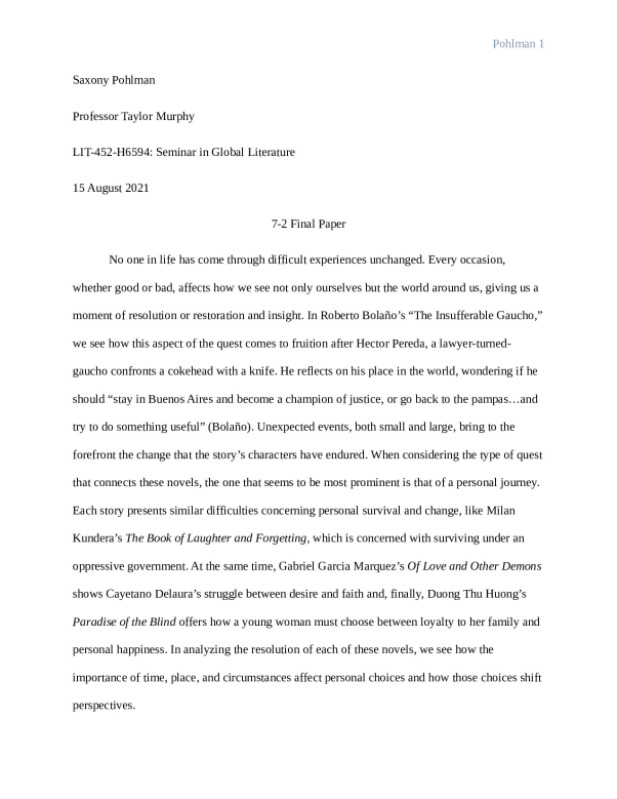
Saxony Pohlman Professor Taylor Murphy LIT-452-H6594: Seminar in Global Literature 15 August 2021 7-2 Final Paper No one in life has come through difficult experiences unchanged. Every occasion, whether good or bad, affects how we see not only ourselves but the world around us, giving us a moment of resolution or restoration and insight. In Roberto Bolaño’s “The Insufferable Gaucho,” we see how this aspect of the quest comes to fruition after Hector Pereda, a lawyer-turnedgaucho confronts a cokehead with a knife. He reflects on his place in the world, wondering if he should “stay in Buenos Aires and become a champion of justice, or go back to the pampas…and try to do something useful” (Bolaño). Unexpected events, both small and large, bring to the forefront the change that the story’s characters have endured. When considering the type of quest that connects these novels, the one that seems to be most prominent is that of a personal journey. Each story presents similar difficulties concerning personal survival and change, like Milan Kundera’s The Book of Laughter and Forgetting, which is concerned with surviving under an oppressive government. At the same time, Gabriel Garcia Marquez’s Of Love and Other Demons shows Cayetano Delaura’s struggle between desire and faith and, finally, Duong Thu Huong’s Paradise of the Blind offers how a young woman must choose between loyalty to her family and personal happiness. In analyzing the resolution of each of these novels, we see how the importance of time, place, and circumstances affect personal choices and how those choices shift perspectives. Pohlman 2 The first foray into connecting these stories through a personal quest and resolution is Milan Kundera’s The Book of Laughter and Forgetting. The book is comprised of seven parts and is a mixture of fictional and autobiographical elements. The autobiographical parts of the novel give us a look at the influence of living under an oppressive government can change one’s identity at the time of the Russian occupation of Czechoslovakia in 1968; Kundera was thirtynine and had been driven away from his job, along with many of his fellow countrymen. As Carolyn Ownbey’s academic critique “Milan Kundera and the Radical Autonomy of Art” informs us, he “was subject to a double politicization of his vocation. On the one hand, within his own country, writers, artists, and intellectuals were forced to fit the socialist cultural program, or they were silenced” (1). The sense of identity is stripped away immediately, and you are left to conform or die. He had friends who offered him work, but he often refused to take anything to keep both himself and them safe. He reflects on how “the secret police wanted to starve us, reduce us to poverty, force us to c
[Show Less]