CHAPTER 16 PROBLEMS
16-24 (Objectives 16-1, 16-2, 16-3) The following are common tests of details of balances or
substantive analytical procedures for the audit of accounts receivable:
1. Select 20 customer accounts from the accounts receivable master file and trace to the
aged accounts receivable listing to verify name and amount.
Completeness; 4th
2. Select 20 customer accounts from the ag
...[Show More]
CHAPTER 16 PROBLEMS
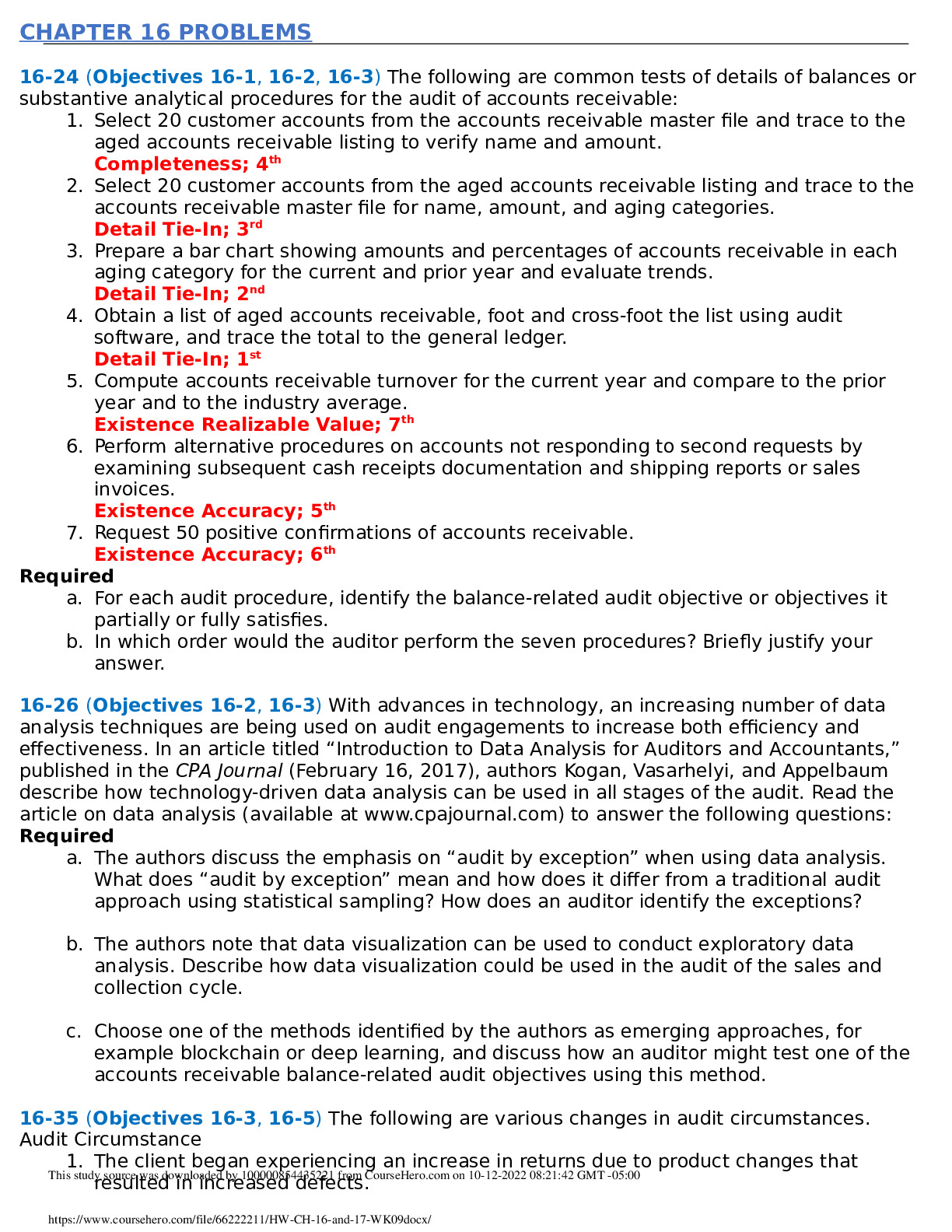
16-24 (Objectives 16-1, 16-2, 16-3) The following are common tests of details of balances or
substantive analytical procedures for the audit of accounts receivable:
1. Select 20 customer accounts from the accounts receivable master file and trace to the
aged accounts receivable listing to verify name and amount.
Completeness; 4th
2. Select 20 customer accounts from the aged accounts receivable listing and trace to the
accounts receivable master file for name, amount, and aging categories.
Detail Tie-In; 3rd
3. Prepare a bar chart showing amounts and percentages of accounts receivable in each
aging category for the current and prior year and evaluate trends.
Detail Tie-In; 2nd
4. Obtain a list of aged accounts receivable, foot and cross-foot the list using audit
software, and trace the total to the general ledger.
Detail Tie-In; 1st
5. Compute accounts receivable turnover for the current year and compare to the prior
year and to the industry average.
Existence Realizable Value; 7th
6. Perform alternative procedures on accounts not responding to second requests by
examining subsequent cash receipts documentation and shipping reports or sales
invoices.
Existence Accuracy; 5th
7. Request 50 positive confirmations of accounts receivable.
Existence Accuracy; 6th
Required
a. For each audit procedure, identify the balance-related audit objective or objectives it
partially or fully satisfies.
b. In which order would the auditor perform the seven procedures? Briefly justify your
answer.
16-26 (Objectives 16-2, 16-3) With advances in technology, an increasing number of data
analysis techniques are being used on audit engagements to increase both efficiency and
effectiveness. In an article titled “Introduction to Data Analysis for Auditors and Accountants,”
published in the CPA Journal (February 16, 2017), authors Kogan, Vasarhelyi, and Appelbaum
describe how technology-driven data analysis can be used in all stages of the audit. Read the
article on data analysis (available at www.cpajournal.com) to answer the following questions:
Req
[Show Less]