Stanford University
CS 255
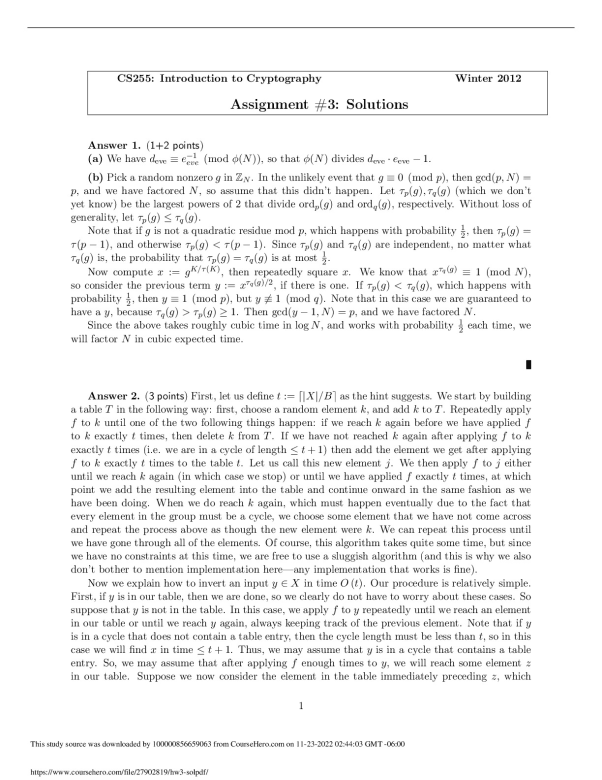
CS255: Introduction to Cryptography Winter 2012 Assignment #3: Solutions Answer 1. (1+2 points) (a) We have deve ≡ e −1 eve (mod φ(N)), so that φ(N) divides deve · eeve − 1. (b) Pick a random nonzero g in ZN . In the unlikely event that g ≡ 0 (mod p), then gcd(p, N) = p, and we have factored N, so assume that this didn’t happen. Let τp
...[Show More]
CS255: Introduction to Cryptography Winter 2012 Assignment #3: Solutions Answer 1. (1+2 points) (a) We have deve ≡ e −1 eve (mod φ(N)), so that φ(N) divides deve · eeve − 1. (b) Pick a random nonzero g in ZN . In the unlikely event that g ≡ 0 (mod p), then gcd(p, N) = p, and we have factored N, so assume that this didn’t happen. Let τp(g), τq(g) (which we don’t yet know) be the largest powers of 2 that divide ordp(g) and ordq(g), respectively. Without loss of generality, let τp(g) ≤ τq(g). Note that if g is not a quadratic residue mod p, which happens with probability 1 2 , then τp(g) = τ (p − 1), and otherwise τp(g) < τ (p − 1). Since τp(g) and τq(g) are independent, no matter what τq(g) is, the probability that τp(g) = τq(g) is at most 1 2 . Now compute x := g K/τ(K) , then repeatedly square x. We know that x τq(g) ≡ 1 (mod N), so consider the previous term y := x τq(g)/2 , if there is one. If τp(g) < τq(g), which happens with probability 1 2 , then y ≡ 1 (mod p), but y 6≡ 1 (mod q). Note that in this case we are guaranteed to have a y, because τq(g) > τp(g) ≥ 1. Then gcd(y − 1, N) = p, and we have factored N. Since the above takes roughly cubic time in log N, and works with probability 1 2 each time, we will factor N in cubic expected time. Answer 2. (3 points) First, let us define t := d|X|/Be as the hint suggests. We start by building a table T in the following way: first, choose a random element k, and add k to T. Repeatedly apply f to k until one of the two following things happen: if we reach k again before we have applied f to k exactly t times, then delete k from T. If we have not reached k again after applying f to k exactly t times (i.e. we are in a cycle of length ≤ t + 1) then add the element we get after applying f to k exactly t times to the table t. Let us call this new element j. We then apply f to j either until we reach k again (in which case we stop) or until we have applied f exactly t times, at which point we add the resulting element into the table and continue onward in the same fashion as we have been doing. When we do reach k again, which must happen eventually due to the fact that every element in the group must be a cycle, we choose some element that we have not come across and repeat the process above as though the new element were k. We can repeat this process until we have gone through all of the elements. Of course, this algorithm tak
[Show Less]