River Ridge High School
PSYCHOLOGY 400
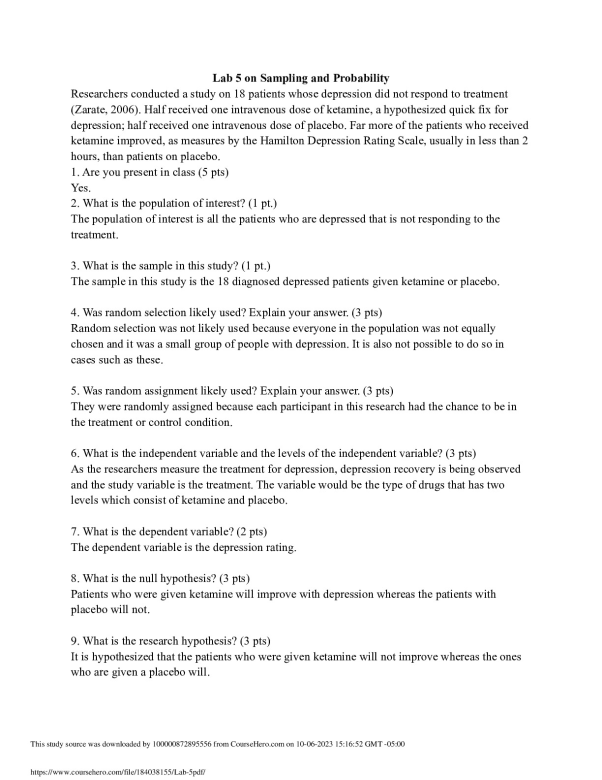
Lab 5 on Sampling and Probability Researchers conducted a study on 18 patients whose depression did not respond to treatment (Zarate, 2006). Half received one intravenous dose of ketamine, a hypothesized quick fix for depression; half received one intravenous dose of placebo. Far more of the patients who received ketamine imp
...[Show More]
Lab 5 on Sampling and Probability Researchers conducted a study on 18 patients whose depression did not respond to treatment (Zarate, 2006). Half received one intravenous dose of ketamine, a hypothesized quick fix for depression; half received one intravenous dose of placebo. Far more of the patients who received ketamine improved, as measures by the Hamilton Depression Rating Scale, usually in less than 2 hours, than patients on placebo. 1. Are you present in class (5 pts) Yes. 2. What is the population of interest? (1 pt.) The population of interest is all the patients who are depressed that is not responding to the treatment. 3. What is the sample in this study? (1 pt.) The sample in this study is the 18 diagnosed depressed patients given ketamine or placebo. 4. Was random selection likely used? Explain your answer. (3 pts) Random selection was not likely used because everyone in the population was not equally chosen and it was a small group of people with depression. It is also not possible to do so in cases such as these. 5. Was random assignment likely used? Explain your answer. (3 pts) They were randomly assigned because each participant in this research had the chance to be in the treatment or control condition.
[Show Less]