Naming Chemical Compounds – Lab Report AssistantExercise 1: Naming Organic CompoundsData Table 1. Hydrocarbon NamesCompound Structure | Compound Name1 | Butane2 | 1-Propyne3 | Ethene4 | 2-Octyne5 | NonaneTiffany Taylor Unit 1 Dr. FlynnData Table 2. Hydrocarbon StructuresCompound Name | Compound Structure1 | 2-pentyne2 | Decane3 | 1-heptyne4 | 4-decyne5 | PropaneTiffany Ta
...[Show More]
Naming Chemical Compounds – Lab Report Assistant
Exercise 1: Naming Organic Compounds
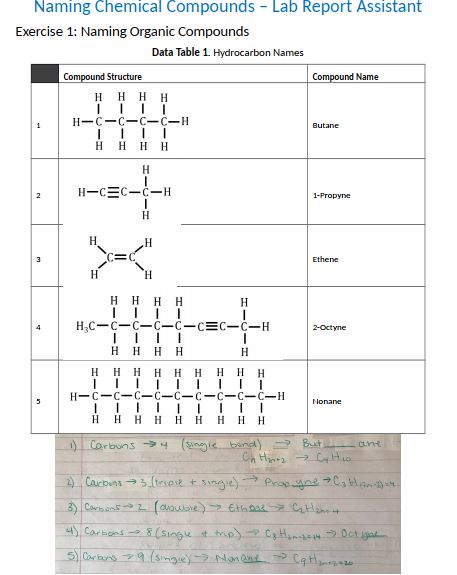
Data Table 1. Hydrocarbon Names
Compound Structure | Compound Name
1 | Butane
2 | 1-Propyne
3 | Ethene
4 | 2-Octyne
5 | Nonane
Tiffany Taylor Unit 1 Dr. Flynn
Data Table 2. Hydrocarbon Structures
Compound Name | Compound Structure
1 | 2-pentyne
2 | Decane
3 | 1-heptyne
4 | 4-decyne
5 | Propane
Tiffany Taylor Unit 1 Dr. Flynn
Tiffany Taylor Unit 1 Dr. Flynn
Data Table 3. Organic Compound Names
Compound Structure | Compound Name
1 | 3-chloropentane
2 | 2,3-difluoro-4-ethyl-
1-hexene
3 | 3-bromo-3-chloro-1-
butyne
4 | 2-bromo-6-ethyl-4-
methyl-3,6,6-
trichloro-1-octene
5 | 4,6-ethyl-6-fluoro-
2,2,8,8-
tetrabromodecane
Tiffany Taylor Unit 1 Dr. Flynn
Tiffany Taylor Unit 1 Dr. Flynn
Data Table 4. Organic Compound Structures
Compound Name | Compound Structure
1 | 3-bromo-2,2-dimethylbutane
2 | 3-bromo-4-ethyl-1,1,1-trifluoro-5-
methylheptane
3 | 5-bromo-4,4-dichloro-1-hexyne
4 | 1,2-dichloroethene
5 | 1,1,1-trichloro-8,8,8-trifluoro-4-octyne
Tiffany Taylor Unit 1 Dr. Flynn
Questions:
A) Determine the molecular formula for the following hydrocarbons:
a. Hexane = C6H14
b. Propyne = C3H4
c. 2-octyne = C8H14
d. Decane = C10H22
e. 4-nonene = C9H18
B) Describe the difference between a saturated hydrocarbon and an unsaturated hydrocarbon.
Name a total of 3 saturated hydrocarbons and a total of 3 unsaturated hydrocarbons from
Data Table 1 and Data Table 2.
A saturated hydrocarbon consists of only single bonds, and it is also referred to as an
alkane. Three examples of this are butane, nonane, and 3-chloropentane. A unsaturated
hydrocarbon consists of at least one double or triple carbon-carbon bond. If it has a double
bond, it is called an alkene and has the suffix “-ene.” Three examples of this are ethene, 2,3-
difluoro-4-ethyl-1-hexene, and 2-bromo-6-ethyl-4-methyl-3,6,6-trichloro-1-octene. If it has
a triple bond, it is called an alkyne, and it has a suffix of “-yne.” Three examples of this are
propyne, octyne, and 3-bromo-3-chloro-1-butyne.
C) In your own words list the rules for naming hydrocarbons and substituted hydrocarbons. Be
detailed in listing all rules including the priority for numbering carbons, prefixes and suffixes,
and the structure of the name.
Exercise 2: Naming Ionic and Molecular Compounds
Data Table 5. Binary Molecular and Ionic Compound Names
Formula | Molecular or Ionic Compound? | Compound Name
15 | PtCl2 | Ionic | Platinum (II) chlorideData Table 6. Binary Molecular and Ionic Compound Formulas
Compound Name | Molecular or Ionic Compound? | Formula
Tiffany Taylor Unit 1 Dr. Flynn
Compound Name | Molecular or Ionic Compound? | Formula
decasulfide | Molecular | P4S10
15 | Potassium chloride | Ionic | KClQuestions:
A) The metals in Group IIIA, IVA, and VA of the periodic table are not transition metals.
However, all but 1 have variable charges. What element in Group IIIA, Period 3 has a fixed
charge, and what is that charge?
Aluminum; it has a charge of +3.
B) Describe the difference between molecular and ionic compounds.
[Show Less]