Lab Report > Lab 7 Notes. Baltimore City Community College ITSA 270
Related tags
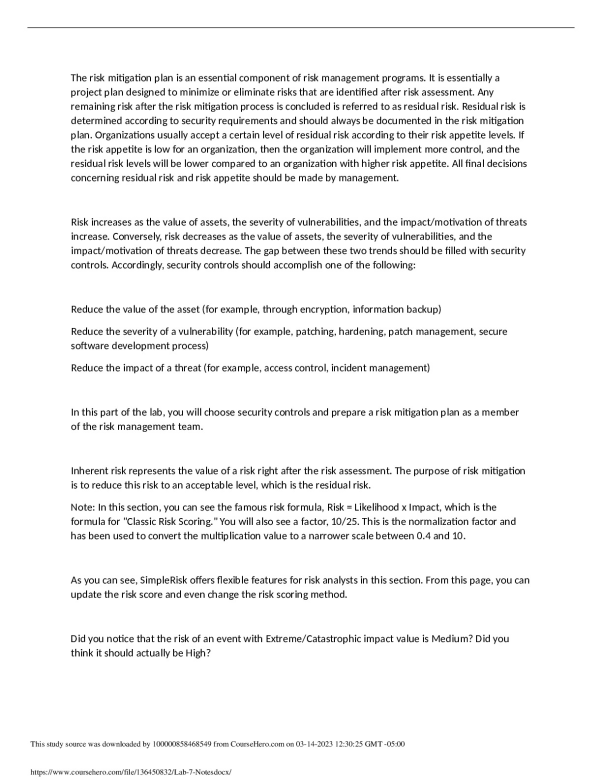
ITSA 270The risk mitigation plan is an essential component of risk management programs. It is essentially a project plan designed to minimize or eliminate risks that are identified after risk assessment. Any remaining risk after the risk mitigation process is concluded is referred to as residual risk. Residual risk is determined according to security requirements and should always be documented in the ...[Show More]
Access Full Document
Instant download
Preview 1 out of 4 pages
Reviews( 0 )
No Recommended Resources Yet.
| Category: | Lab Report |
| Number of pages: | 4 |
| Language: | English |
| Last updated: | 3 years ago |
| Downloads: | 0 |
| Views: | 48 |