FIN MISC Assignment 2 | Graded Assignment 2 | FIN402x Courseware | edX
Course Risk & … Graded… Assign…
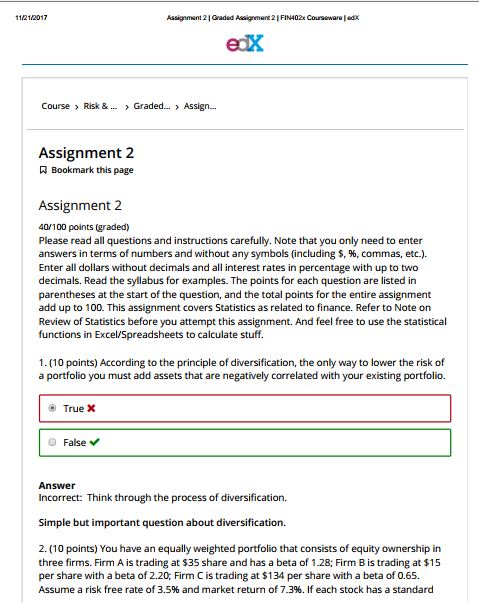
Assignment 2
Please read all questions and instructions carefully. Note that you only need to enter
answers in terms of numbers and without any symbols (including $, %, commas, etc.).
Enter all dollars without decimals and all interest rates in percentage with up to two
decimals. Read the syllabus for examples. The points for each question are listed in
parentheses at the start of the question, and the total points for the entire assignment
add up to 100. This assignment covers Statistics as related to Ònance. Refer to Note on
Review of Statistics before you attempt this assignment. And feel free to use the statistical
functions in Excel/Spreadsheets to calculate stu×.
1. (10 points) According to the principle of diversiÒcation, the only way to lower the risk of
a portfolio you must add assets that are negatively correlated with your existing portfolio.
2. (10 points) You have an equally weighted portfolio that consists of equity ownership in
three Òrms. Firm A is trading at $35 share and has a beta of 1.28; Firm B is trading at $15
per share with a beta of 2.20; Firm C is trading at $134 per share with a beta of 0.65.
Assume a risk free rate of 3.5% and market return of 7.3%. If each stock has a standard
True
False
Simple but important question about diversiÒcation.
3. (10 points) You have a portfolio that consists of equity ownership in three Òrms. You
own 600 shares of Stout Drink Company (SDC), 700 shares of Carbon Computing (CC) and
350 shares of Serrano Foods (SF). Their current share prices are $100, $38, and $146,
respectively. What is the percentage weight of SF in your portfolio? (Allow two decimals in
4. (10 points) With everyone nervous about their investments after the recent Ònancial
crisis, suppose a new Òrm, Safety Net Insurance (SNI), emerges to sell people insurance
against poorly performing markets in exchange for an annual premium. Suppose you
decide to purchase one of these insurance contracts from SNI. You would expect that such
an investment would have a beta that is
5.23%
11.77%
13.55%
8.73%
5. (10 points) Suppose there are three securities (A, B, and C) to choose from to create
your portfolio. Next year the economy will be in an expansion, normal, or recession state
with probabilities 0.35, 0.37, and 0.28, respectively. The returns (%) on the securities in
these states are as follows: Security A {expansion = +8, normal = +7, recession = +2};
6. (10 points) The FTSE 100 is an index of the 100 largest market capitalization stocks
traded on the London Stock Exchange. You think that 100 stocks are too much to keep up
with, so you want to drop that number to 35. By doing this, what is the percentage drop in
the UNIQUE relations between any two stocks in your portfolio that you will have to worry
about? (Allow two decimals in the percentage but do not enter the % sign.)
Negative.
Basic intuition of beta, or systematic risk.
Portfolio II.
Portfolio IV.
Portfolio I.
Portfolio III.
43.54 Answer: [87.10, 88.86]
7. (10 points) The CAPM states that the realized/actual return on an asset in any period will
be the risk free rate plus beta times the market risk premium.
8. (10 points) Suppose CAPM works, and you know that the expected returns on Google
and IBM are estimated to be 13.25% and 10.50%, respectively. You have just calculated
extremely reliable estimates of the betas of Google and IBM to be 1.32 and 0.88,
respectively. Given this data, what is a reasonable estimate of the market risk-premium in
percentage (the average/expected di×erence between the market return and the risk-free
rate)? (Allow two decimals in the percentage but do not enter the % sign.)
An important calculation to emphasize the importance of relations among stocks in a
portfolio.
True
False
Testing your understanding of the CAPM and its key determinants.
9. (10 points) The standard deviation of a portfolio's return is the weighted average of the
standard deviations of the returns of all securities in the portfolio, where the weights are
proportional to the amount of your investment in a security relative to your total
investment.
10. (10 points) Your company is very well-diversiÒed, producing and selling all kinds of
goods and services, with each division being approximately of the same value/size. The
beta of your company is therefore e×ectively 1.00. The market risk premium (the
average/expected di×erence between the market return and the risk-free rate) is 8.25%
and the return on a long-term government bond is 5.25%. You have discovered an exciting
opportunity to create a new medicine that will cure the common cold. This project will
require a $1 billion investment, spread out equally between now (t = 0) and the end of this
year (t = 1), and will produce $156 million dollars in perpetuity starting in year 2 (t = 2).
Should you propose this investment to your CEO?
False
True
Again, a basic but important, relation between the risks of portfolios and individual
securities. Go back to basics.
It can't be decided until the systematic risk of the project can be quantiÒed.
It can't be decided even if the systematic risk of the project can be quantiÒed.
No.
Yes.
An issue that is more important to valuation than any other.