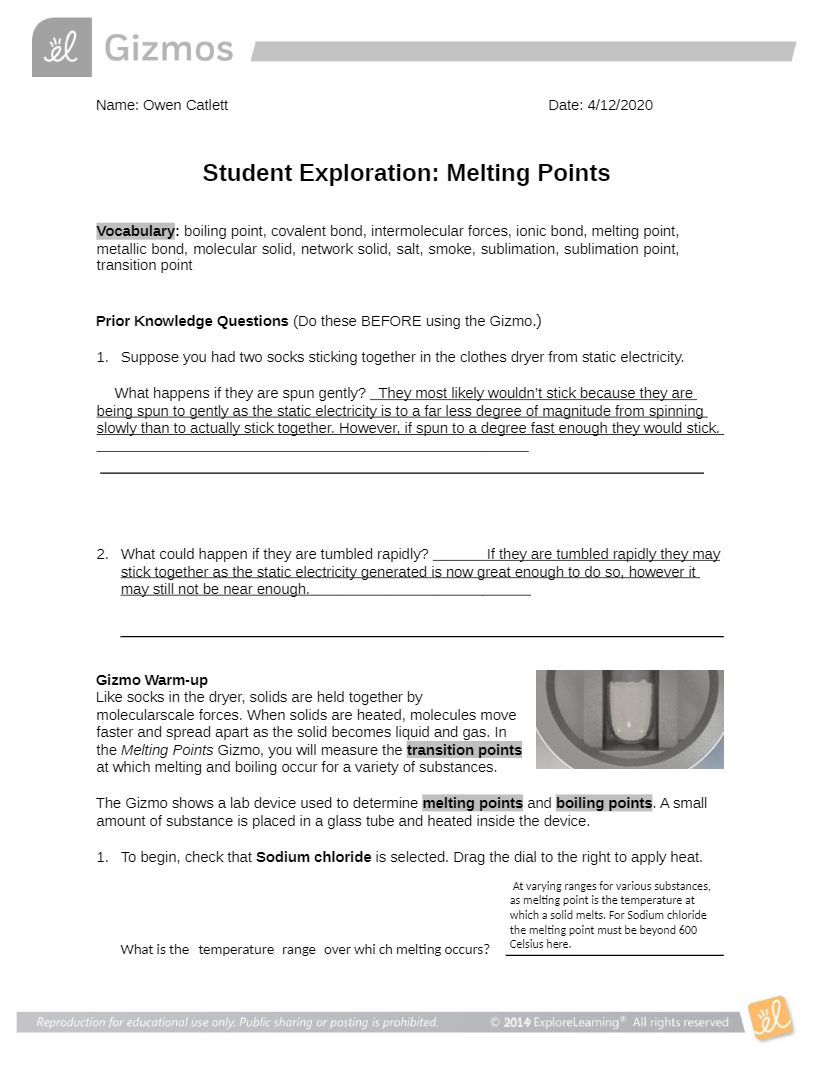
Vocabulary: boiling point, covalent bond, intermolecular forces, ionic bond, melting point, metallic bond, molecular solid, network solid, salt, smoke, sublimation, sublimation point, transition point Prior Knowledge Questions (Do these BEFORE using the Gizmo.) 1. Suppose you had two socks sticking together in the clothes dryer from static electricity. What happens
...[Show More]
Vocabulary: boiling point, covalent bond, intermolecular forces, ionic bond, melting point, metallic bond, molecular solid, network solid, salt, smoke, sublimation, sublimation point, transition point
Prior Knowledge Questions (Do these BEFORE using the Gizmo.)
1. Suppose you had two socks sticking together in the clothes dryer from static electricity.
What happens if they are spun gently
2. What could happen if they are tumbled rapidly?
1. To begin, check that Sodium chlorideis selected. Drag the dial to the right to apply heat.
A. When the temperature is around 600 °C, drag the dial back to 0. Notice that the sodium chloride is red-hot, but it is still a solid.
B. Drag the dial to the right. When the sodium chloride melts, move the dial back to 0.
About what temperature does sodium chloride melt?
The temperature that it melts is around 800 Celsius here the range most likely is 800-805
2. Click Reset. This time, decrease the setting on the dial as you get close to the melting point. Notice that melting occurs over a range of temperatures. Can you determine the exact range of temperatures over which melting occurs? (This may take several tries, be patient.)
The exact range at which the melting occurs of Sodium chloride is 797 degrees Celsius (the very beginning of signs being shown) to 803 degrees Celsius
| Activity A: Covalent compounds | Get the Gizmo ready: • Select the COLD ROOM tab. • Turn on Show molecular view. • Check that Water is selected. |
Introduction: A cold room is used to find the melting points of substances that are liquids or gases at room temperature. This simulated cold room has a temperature of -120 °C.
Question: What happens when a substance melts?
1. Observe: Look at the molecular view of water.
A. What do you see?
The atoms in each water molecule are held together by covalent bonds. The molecules are held together by intermolecular forces. This kind of substance is called a molecular solid.
B. In the solid state, do the molecules move around freely or are they stuck in position?
C. Using the Gizmo, determine the melting point and boiling point of water. To find the approximate melting and boiling points you can heat the sample quickly. Then, run another trial at a slower speed to find the exact temperatures.
Melting point: Boiling point: 100 degrees Celsius
D. Do the molecules move around more or less when water is a liquid?
2. Experiment: Record the melting point and boiling point of water in the table below. Then, use the Gizmo to find the melting and boiling points of hydrogen sulfide and ethanol. In each case, record the range of temperature for each transition.
| | |
| Chemical | Melting point (°C) | Boiling point (°C) | Other transition point (°C)