Question
Answered step-by-step
Asked by tnatalie164
The Oil Blending Problem: An oil company produces three brands of...
The Oil Blending Problem:
An oil company produces three brands of oils: Regular, Multigrade, and Supreme. Each brand of oil is composed of one or more of four crude stocks (the same as "raw petroleum"), each having a different viscosity index. Viscosity is a mea
...[Show More]
Question
Answered step-by-step
Asked by tnatalie164
The Oil Blending Problem: An oil company produces three brands of...
The Oil Blending Problem:
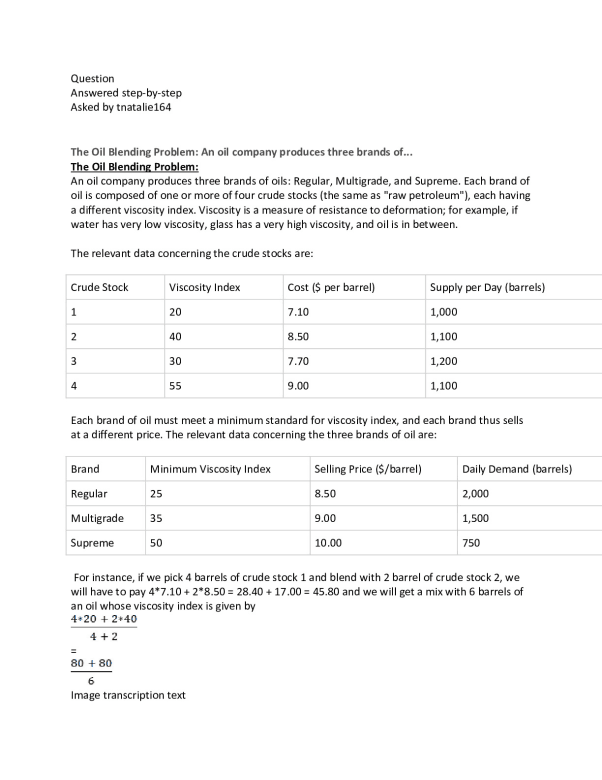
An oil company produces three brands of oils: Regular, Multigrade, and Supreme. Each brand of oil is composed of one or more of four crude stocks (the same as "raw petroleum"), each having a different viscosity index. Viscosity is a measure of resistance to deformation; for example, if water has very low viscosity, glass has a very high viscosity, and oil is in between.
The relevant data concerning the crude stocks are:
| Crude Stock |
Viscosity Index |
Cost ($ per barrel) |
Supply per Day (barrels) |
| 1 |
20 |
7.10 |
1,000 |
| 2 |
40 |
8.50 |
1,100 |
| 3 |
30 |
7.70 |
1,200 |
| 4 |
55 |
9.00 |
1,100 |
Each brand of oil must meet a minimum standard for viscosity index, and each brand thus sells at a different price. The relevant data concerning the three brands of oil are:
| Brand |
Minimum Viscosity Index |
Selling Price ($/barrel) |
Daily Demand (barrels) |
| Regular |
25 |
8.50 |
2,000 |
| Multigrade |
35 |
9.00 |
1,500 |
| Supreme |
50 |
10.00 |
750 |
For instance, if we pick 4 barrels of crude stock 1 and blend with 2 barrel of crude stock 2, we will have to pay 4*7.10 + 2*8.50 = 28.40 + 17.00 = 45.80 and we will get a mix with 6 barrels of an oil whose viscosity index is given by
[Show Less]