Western University
MOS 3367
1.1 (Learning objective 1-1) What is fraud examination?
1-2 (Learning objective 1-2) What is the fraud theory
approach?
Analyze available date, create hypothesis, test hypothesis, redefine/amend hypothesis
1.2 (Learning objective 1-3) Occupational fraud and abuse includes any personal enrichment that
results from misuse or mis-
...[Show More]
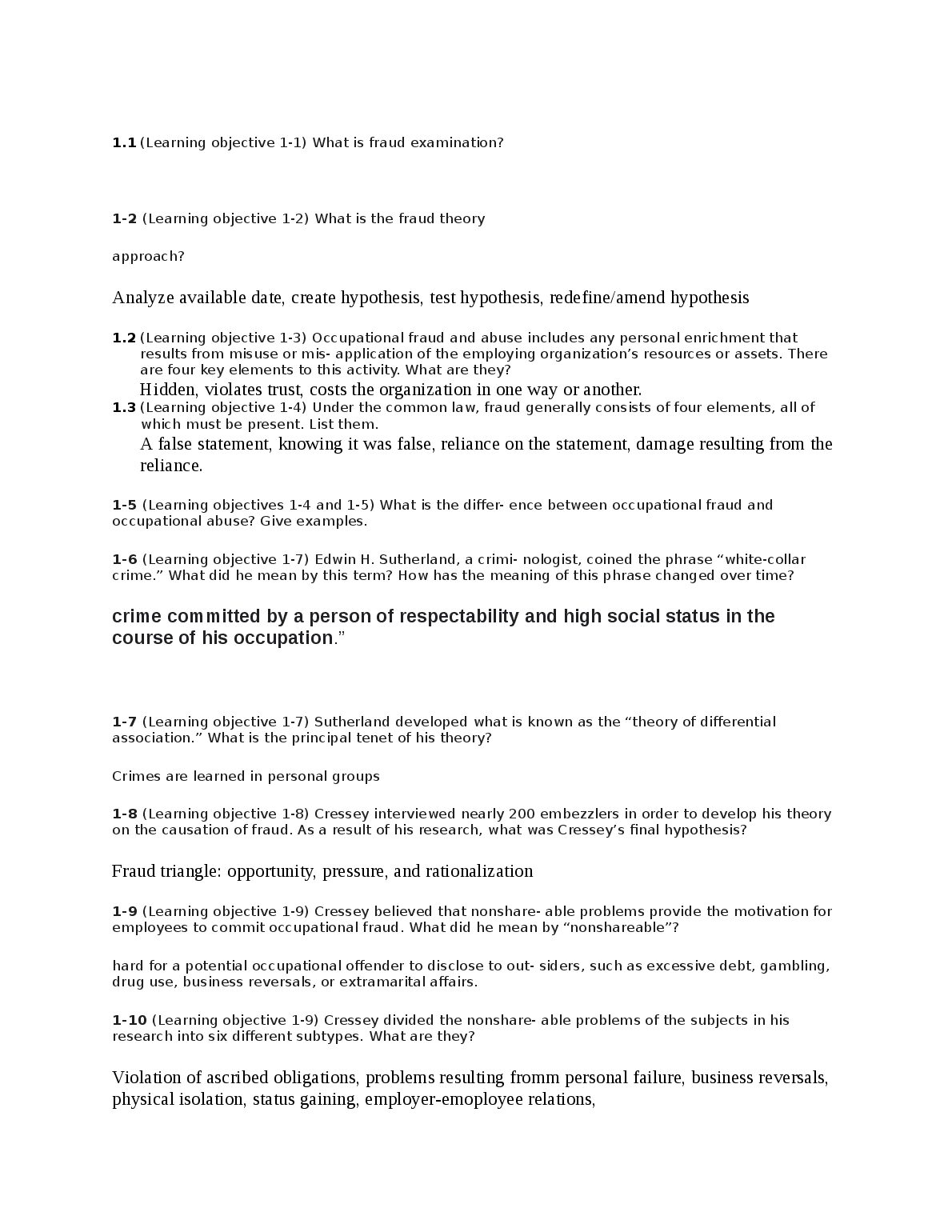
1.1 (Learning objective 1-1) What is fraud examination?
1-2 (Learning objective 1-2) What is the fraud theory
approach?
Analyze available date, create hypothesis, test hypothesis, redefine/amend hypothesis
1.2 (Learning objective 1-3) Occupational fraud and abuse includes any personal enrichment that
results from misuse or mis- application of the employing organization’s resources or assets. There
are four key elements to this activity. What are they?
Hidden, violates trust, costs the organization in one way or another.
1.3 (Learning objective 1-4) Under the common law, fraud generally consists of four elements, all of
which must be present. List them.
A false statement, knowing it was false, reliance on the statement, damage resulting from the
reliance.
1-5 (Learning objectives 1-4 and 1-5) What is the differ- ence between occupational fraud and
occupational abuse? Give examples.
1-6 (Learning objective 1-7) Edwin H. Sutherland, a crimi- nologist, coined the phrase “white-collar
crime.” What did he mean by this term? How has the meaning of this phrase changed over time?
crime committed by a person of respectability and high social status in the
course of his occupation.”
1-7 (Learning objective 1-7) Sutherland developed what is known as the “theory of differential
association.” What is the principal tenet of his theory?
Crimes are learned in personal groups
1-8 (Learning objective 1-8) Cressey interviewed nearly 20 0 embezzlers in order to develop his theory
on the causation of fraud. As a result of his research, what was Cressey’s final hypothesis?
Fraud triangle: opportunity, pressure, and rationalization
1-9 (Learning objective 1-9) Cressey believed that nonshare- able problems provide the motivation for
employees to commit occupational fraud. What did he mean by “nonshareable”?
hard for a potential occupational offender to disclose to out- siders, such as excessive debt, gambling,
drug use, business reversals, or extramarital affairs.
1-10 (Learning objective 1-9) Cressey divided the nonshare- able problems of the subjects in his
research into six different subtypes. What are they?
Violation of ascribed obligations, problems resulting fromm personal failure, business reversals,
physical isolation, status gaining, employer-emoployee relations,
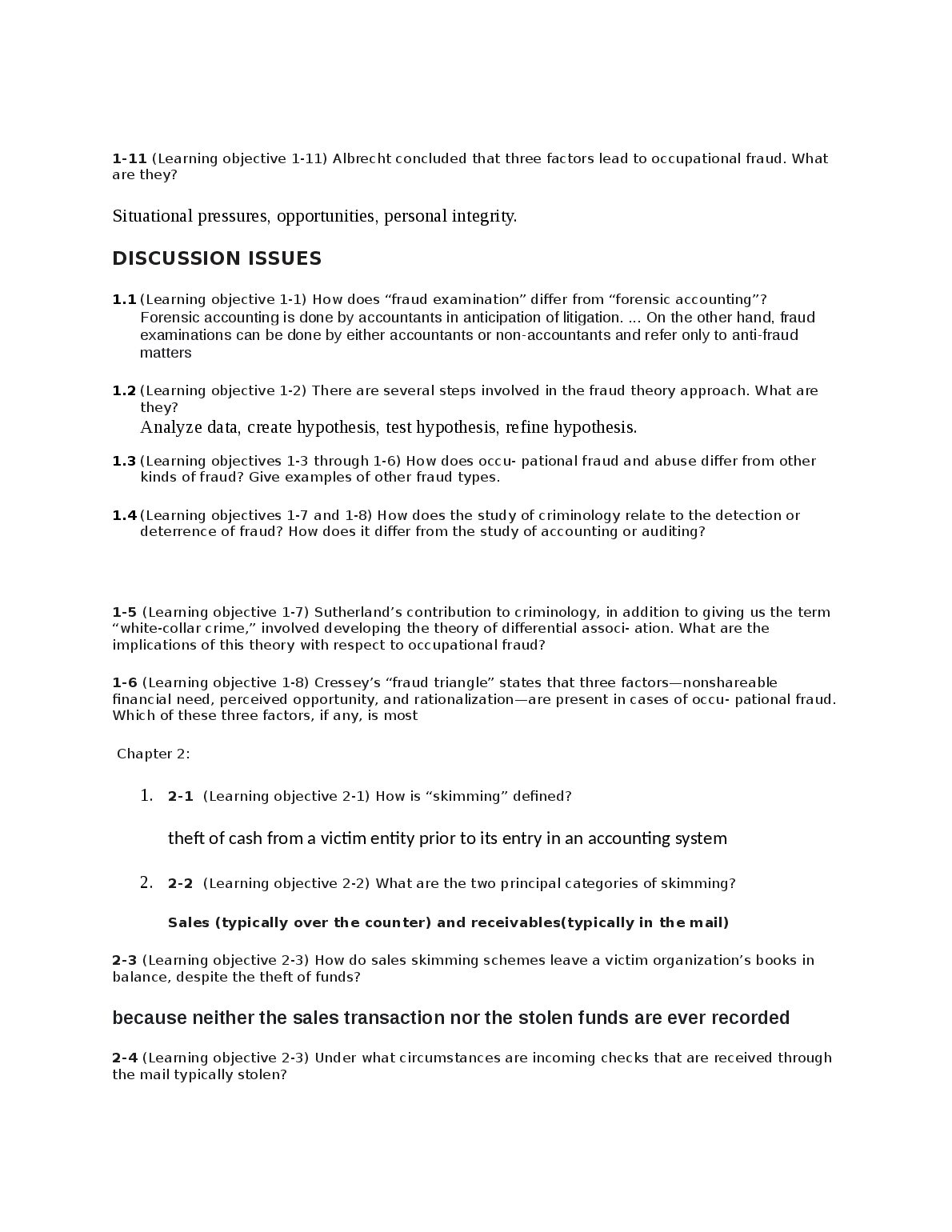
1-11 (Learning objective 1-11) Albrecht concluded that three factors lead to occupational fraud. What
are they?
Situational pressures, opportunities, personal integrity.
DISCUSSION ISSUES
1.1 (Learning objective 1-1) How does “fraud examination” differ from “forensic accounting”?
Forensic accounting is done by accountants in anticipation of litigation. ... On the other hand, fraud
examinations can be done by either accountants or non-accountants and refer only to anti-fraud
matters
1.2 (Learning objective 1-2) There are several steps involved in the fraud theory approach. What are
they?
Analyze data, create hypothesis, test hypothesis, refine hypothesis.
1.3 (Learning objectives 1-3 through 1-6) How does occu- pational fraud and abuse differ from other
kinds of fraud? Give examples of other fraud types.
1.4 (Learning objectives 1-7 and 1-8) How does the study of criminology relate to the detection or
deterrence of fraud? How does it differ from the study of accounting or auditing?
1-5 (Learning objective 1-7) Sutherland’s contribution to criminology, in addition to giving us the term
“white-collar crime,” involved developing the theory of differential associ- ation. What are the
implications of this theory with respect to occupational fraud?
1-6 (Learning objective 1-8) Cressey’s “fraud triangle” states that three factors—nonshareable
financial need, perceived opportunity, and rationalization—are present in cases of occu- pational fraud.
Which of these three factors, if any, is most
Chapter 2:
1. 2-1 (Learning objective 2-1) How is “skimming” defined?
theft of cash from a victim entity prior to its entry in an accounting system
2. 2-2 (Learning objective 2-2) What are the two principal categories of skimming?
Sales (typically over the counter) and receivables(typically in the mail)
2-3 (Learning objective 2-3) How do sales skimming schemes leave a victim organization’s books in
balance, despite the theft of funds?
because neither the sales transaction nor the stolen funds are ever recorded
2-4 (Learning objective 2-3) Under what circumstances are incoming checks that are received through
the mail typically stolen?
[Show Less]