QUIZ > University of MacauGEST 1004Quiz 7 Solution
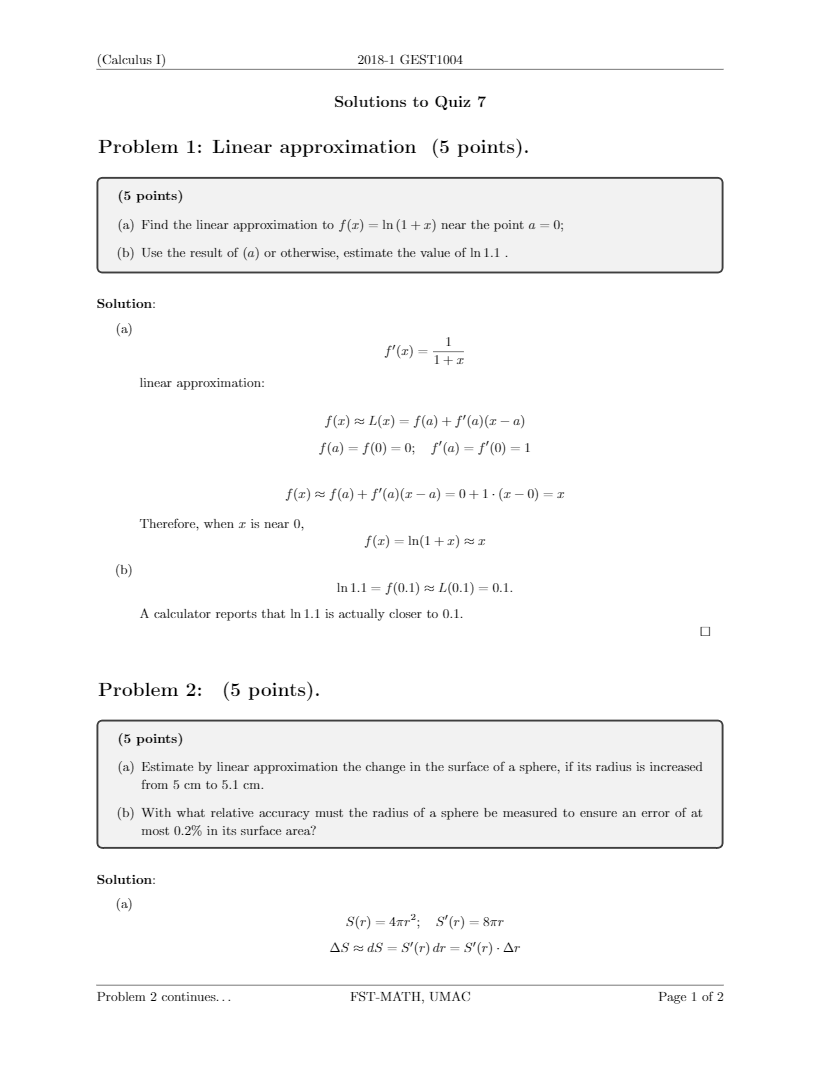
Solutions to Quiz 7Problem 1: Linear approximation (5 points).(5 points)(a) Find the linear approximation to f(x) = ln (1 + x) near the point a = 0;(b) Use the result of (a) or otherwise, estimate the value of ln 1:1 .Solution:(a)f0(x) = 11 + xlinear approximation:f(x) ≈ L(x) = f(a) + f0(a)(x - a)f(a) = f(0) = 0; f0(a) = f0(0) = 1f(x) ≈ f(a) + f0(a)(x - a) = 0 + 1 · (x - 0) = xTherefore, when ...[Show More]
Access Full Document
Instant download
Preview 1 out of 2 pages
Reviews( 0 )
No Recommended Resources Yet.
| Category: | QUIZ |
| Number of pages: | 2 |
| Language: | English |
| Last updated: | 5 years ago |
| Downloads: | 2 |
| Views: | 43 |