Gateway Technical College
NURSING 806-177
Lab 4: The Endocrine System
This activity requires you to identify, describe, discuss, or explain key components in the body. The lab
activities below are designed to aid your understanding of the lecture content. Some of the activities will be
completed entirely in the Visible Body interface. Other activities are provided in thi
...[Show More]
Lab 4: The Endocrine System
This activity requires you to identify, describe, discuss, or explain key components in the body. The lab
activities below are designed to aid your understanding of the lecture content. Some of the activities will be
completed entirely in the Visible Body interface. Other activities are provided in this document.
Visible Body:
Access Visible Body to complete the tasks listed below.
1. Complete the modules, anatomy ID, practice quizzes, and graded quizzes assigned under ‘Endocrine
System.’
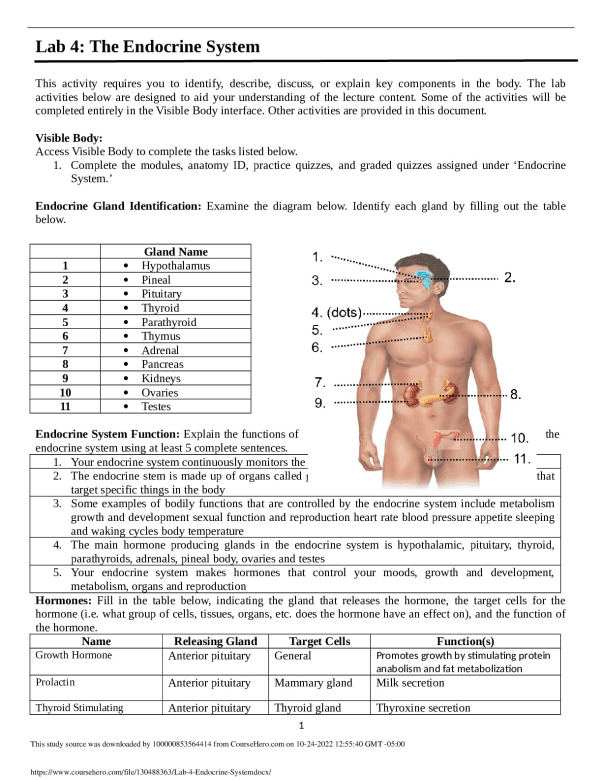
Endocrine Gland Identification: Examine the diagram below. Identify each gland by filling out the table
below.
Gland Name
1 Hypothalamus
2 Pineal
3 Pituitary
4 Thyroid
5 Parathyroid
6 Thymus
7 Adrenal
8 Pancreas
9 Kidneys
10 Ovaries
11 Testes
Endocrine System Function: Explain the functions of the
endocrine system using at least 5 complete sentences.
1. Your endocrine system continuously monitors the number of hormones in your blood.
2. The endocrine stem is made up of organs called glands, produce and release different hormones that
target specific things in the body
3. Some examples of bodily functions that are controlled by the endocrine system include metabolism
growth and development sexual function and reproduction heart rate blood pressure appetite sleeping
and waking cycles body temperature
4. The main hormone producing glands in the endocrine system is hypothalamic, pituitary, thyroid,
parathyroids, adrenals, pineal body, ovaries and testes
5. Your endocrine system makes hormones that control your moods, growth and development,
metabolism, organs and reproduction
Hormones: Fill in the table below, indicating the gland that releases the hormone, the target cells for the
hormone (i.e. what group of cells, tissues, organs, etc. does the hormone have an effect on), and the function of
the hormone.
[Show Less]