University of British Columbia
CHEM_V 123
CHEM123: Experiment #9: Chemical and Nutritional Aspects of Vitamin C: A Project
Abstract:
The degradation of vitamin C (ascorbic acid) by acidity in apple juice was determined by iodometric
titration of 25mL juice samples using potassium iodate (KIO3) and was found to have decreasing levels
of ascorbic acid when 1mL and 2
...[Show More]
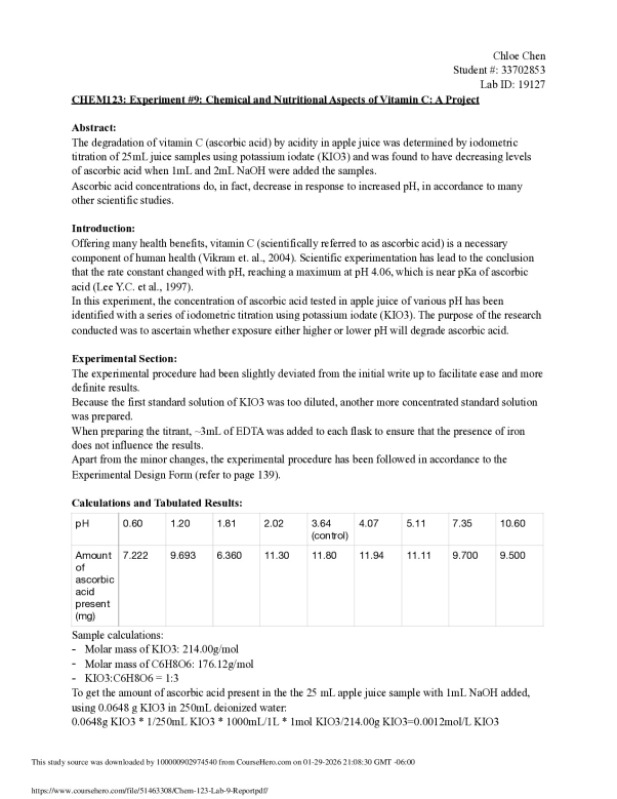
CHEM123: Experiment #9: Chemical and Nutritional Aspects of Vitamin C: A Project
Abstract:
The degradation of vitamin C (ascorbic acid) by acidity in apple juice was determined by iodometric
titration of 25mL juice samples using potassium iodate (KIO3) and was found to have decreasing levels
of ascorbic acid when 1mL and 2mL NaOH were added the samples.
Ascorbic acid concentrations do, in fact, decrease in response to increased pH, in accordance to many
other scientific studies.
Introduction:
Offering many health benefits, vitamin C (scientifically referred to as ascorbic acid) is a necessary
component of human health (Vikram et. al., 2004). Scientific experimentation has lead to the conclusion
that the rate constant changed with pH, reaching a maximum at pH 4.06, which is near pKa of ascorbic
acid (Lee Y.C. et al., 1997).
In this experiment, the concentration of ascorbic acid tested in apple juice of various pH has been
identified with a series of iodometric titration using potassium iodate (KIO3). The purpose of the research
conducted was to ascertain whether exposure either higher or lower pH will degrade ascorbic acid.
[Show Less]