University of Illinois, Urbana Champaign CS361_Project
CS361: Probability and Statistics for Computer Science
Eshaan Bhattad
Project
May 5, 2021
Exercise 1
Prove that E[g(θ)] = f(θ):
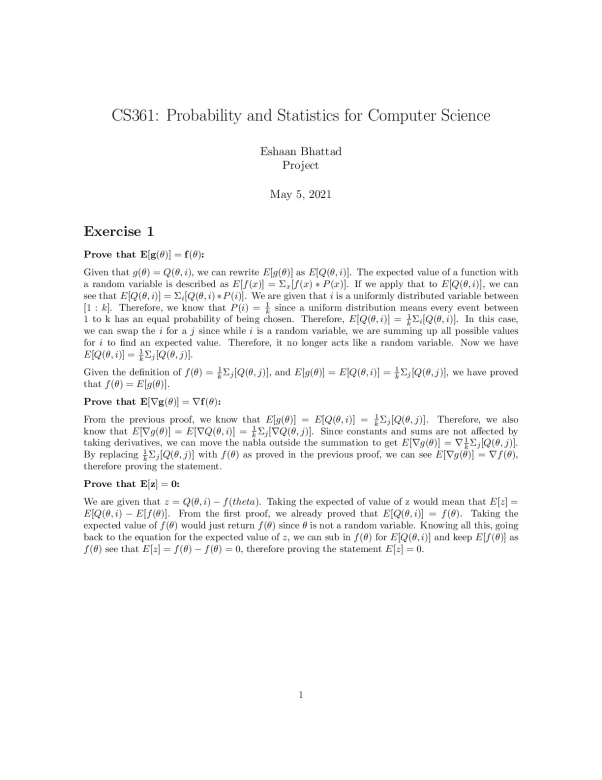
Given that g(θ) = Q(θ; i), we can rewrite E[g(θ)] as E[Q(θ; i)]. The expected value of a function with
a random variable is described as E[f(x)] = Σx[f(x) ∗ P (x)]. If we apply that to E[Q(θ; i)],
...[Show More]
University of Illinois, Urbana Champaign CS361_Project
CS361: Probability and Statistics for Computer Science
Eshaan Bhattad
Project
May 5, 2021
Exercise 1
Prove that E[g(θ)] = f(θ):
Given that g(θ) = Q(θ; i), we can rewrite E[g(θ)] as E[Q(θ; i)]. The expected value of a function with
a random variable is described as E[f(x)] = Σx[f(x) ∗ P (x)]. If we apply that to E[Q(θ; i)], we can
see that E[Q(θ; i)] = Σi[Q(θ; i) ∗ P (i)]. We are given that i is a uniformly distributed variable between
[1 : k]. Therefore, we know that P (i) = k1 since a uniform distribution means every event between
1 to k has an equal probability of being chosen. Therefore, E[Q(θ; i)] = k1 Σi[Q(θ; i)]. In this case,
we can swap the i for a j since while i is a random variable, we are summing up all possible values
for i to find an expected value. Therefore, it no longer acts like a random variable. Now we have
E[Q(θ; i)] = k1 Σj[Q(θ; j)].
Given the definition of f(θ) = k1 Σj[Q(θ; j)], and E[g(θ)] = E[Q(θ; i)] = k1 Σj[Q(θ; j)], we have proved
that f(θ) = E[g(θ)].
Prove that E[rg(θ)] = rf(θ):
From the previous proof, we know that E[g(θ)] = E[Q(θ; i)] = k1 Σj[Q(θ; j)]. Therefore, we also
know that E[rg(θ)] = E[rQ(θ; i)] = k1 Σj[rQ(θ; j)]. Since constants and sums are not affected by
taking derivatives, we can move the nabla outside the summation to get E[rg(θ)] = rk1 Σj[Q(θ; j)].
By replacing k1 Σj[Q(θ; j)] with f(θ) as proved in the previous proof, we can see E[rg(θ)] = rf(θ),
therefore proving the statement.
Prove that E[z] = 0:
We are given that z = Q(θ; i) - f(theta). Taking the expected of value of z would mean that E[z] =
E[Q(θ; i) - E[f(θ)]. From the first proof, we already proved that E[Q(θ; i)] = f(θ). Taking the
expected value of f(θ) would just return f(θ) since θ is not a random variable. Knowing all this, going
back to the equation for the expected value of z, we can sub in f(θ) for E[Q(θ; i)] and keep E[f(θ)] as
f(θ) see that E[z] = f(θ) - f(θ) = 0, therefore proving the statemen
[Show Less]