Stuyvesant High School
MATHEMATIC math
Geometry - Final Study Guide
MGS 21QT
Table of Contents:
LOGIC............1-2
GEOMETRY............2-1
1
General Definitions..........2
Basic Algebra Properties........3
General Theorems/Postulates.......3
Justifications for Constructions..........3-4
Congruent Triangles............4
Triangle
Prop
...[Show More]
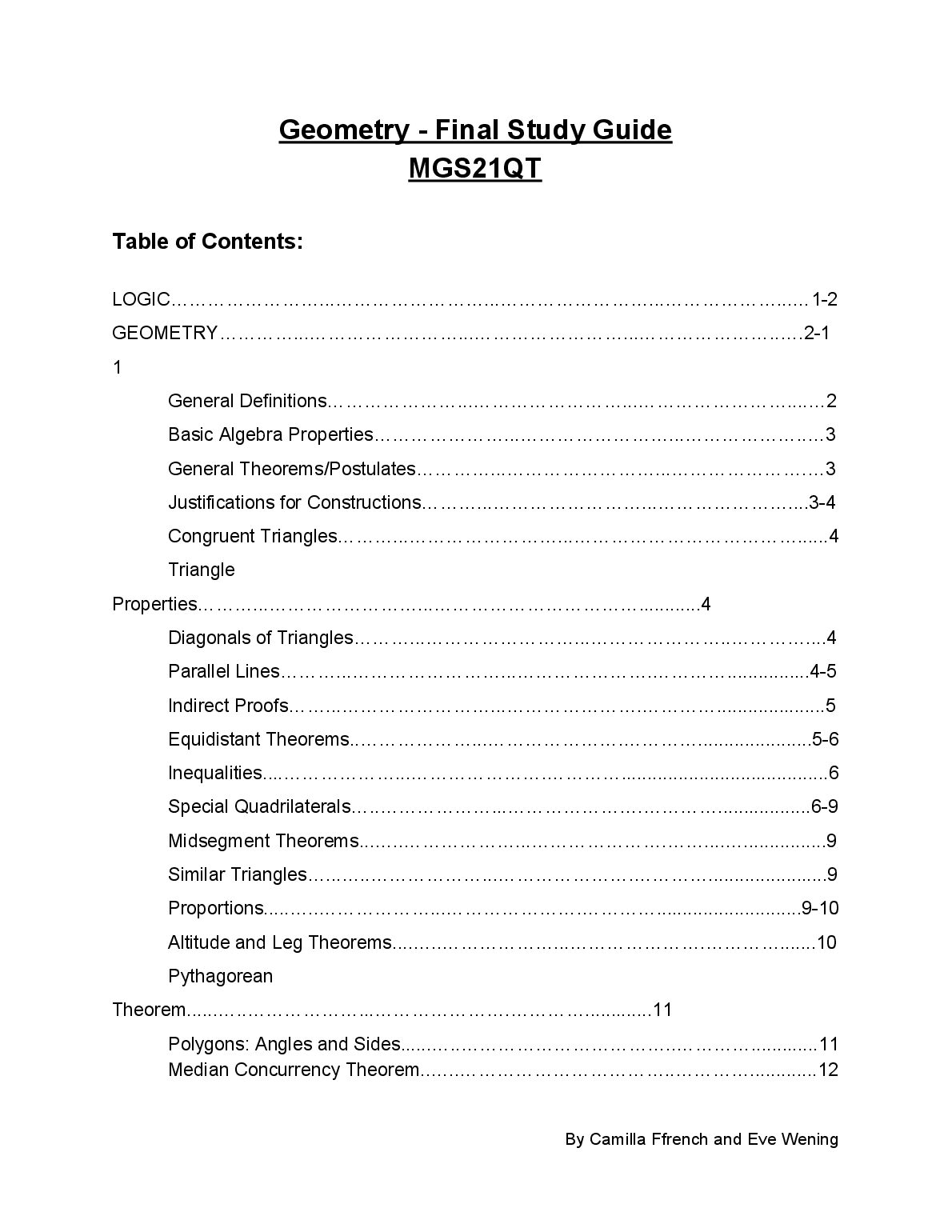
Geometry - Final Study Guide
MGS 21QT
Table of Contents:
LOGIC............1-2
GEOMETRY............2-1
1
General Definitions..........2
Basic Algebra Properties........3
General Theorems/Postulates.......3
Justifications for Constructions..........3-4
Congruent Triangles............4
Triangle
Properties..................4
Diagonals of Triangles............4
Parallel Lines.......................4-5
Indirect Proofs............................5
Equidistant Theorems............................5-6
Inequalities................................................6
Special Quadrilaterals........................6-9
Midsegment Theorems.............................9
Similar Triangles................................9
Proportions.......................................9-10
Altitude and Leg Theorems.................10
Pythagorean
Theorem.........................11
Polygons: Angles and Sides.......................11
Median Concurrency Theorem...................12
By Camilla Ffrench and Eve Wening
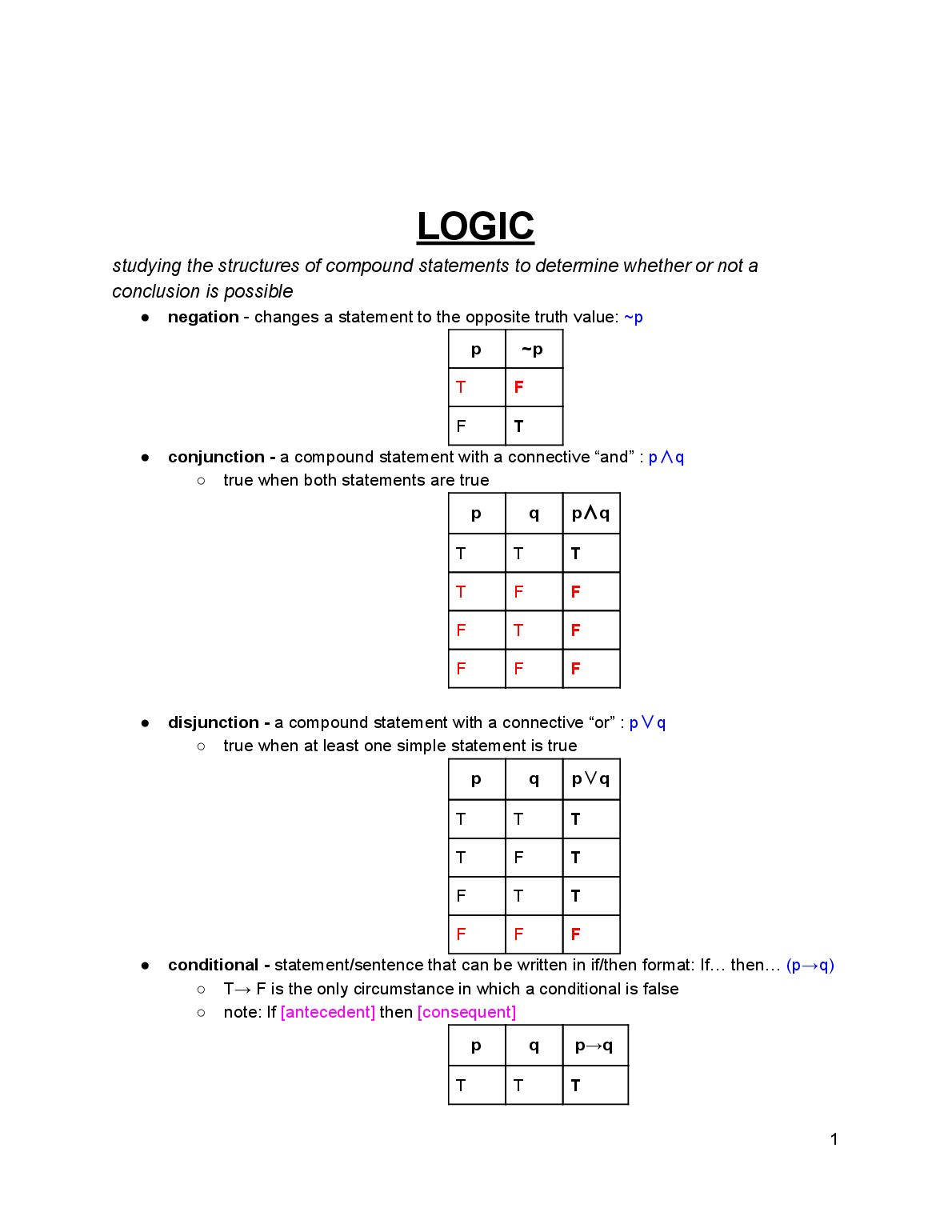
LOGIC
studying the structures of compound statements to determine whether or not a
conclusion is possible
● negation - changes a statement to the opposite truth value: ~p
p ~p
T F
F T
● conjunction - a compound statement with a connective “and” : p∧q
○ true when both statements are true
p q p∧q
T T T
T F F
F T F
F F F
● disjunction - a compound statement with a connective “or” : p∨q
○ true when at least one simple statement is true
p q p∨q
T T T
T F T
F T T
F F F
● conditional - statement/sentence that can be written in if/then format: If then (p→q)
○ T→ F is the only circumstance in which a conditional is false
○ note: If [antecedent] then [consequent]
p q p→q
T T T
1
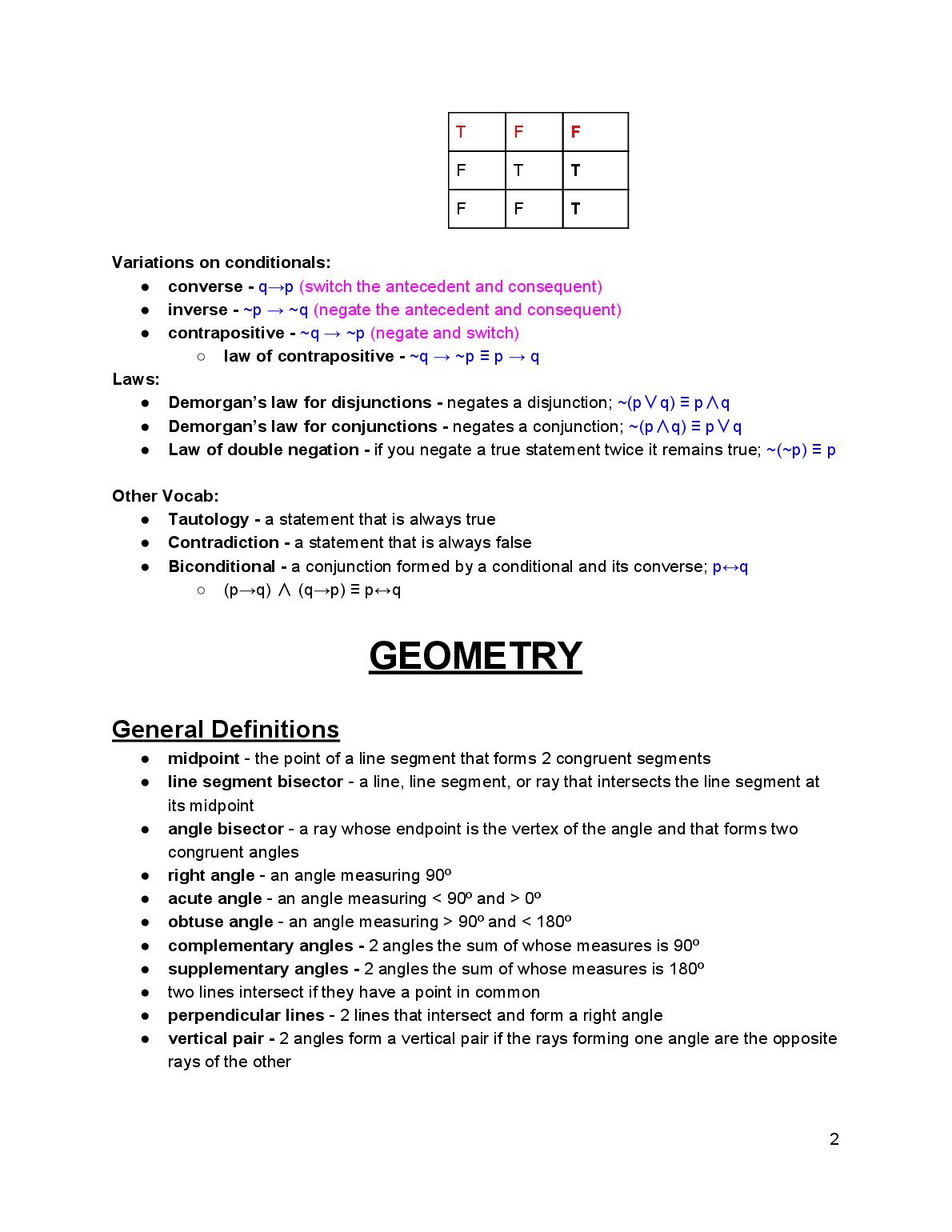
T F F
F T T
F F T
Variations on conditionals:
● converse - q→p (switch the antecedent and consequent)
● inverse - ~p → ~q (negate the antecedent and consequent)
● contrapositive - ~q → ~p (negate and switch)
○ law of contrapositive - ~q → ~p ≡ p → q
Laws:
● Demorgan’s law for disjunctions - negates a disjunction; ~(p∨q) ≡ p∧q
● Demorgan’s law for conjunctions - negates a conjunction; ~(p∧q) ≡ p∨q
● Law of double negation - if you negate a true statement twice it remains true; ~(~p) ≡ p
Other Vocab:
● Tautology - a statement that is always true
● Contradiction - a statement that is always false
● Biconditional - a conjunction formed by a conditional and its converse; p↔q
○ (p→q) ∧ (q→p) ≡ p↔q
[Show Less]