University of Calgary
ARKY 205
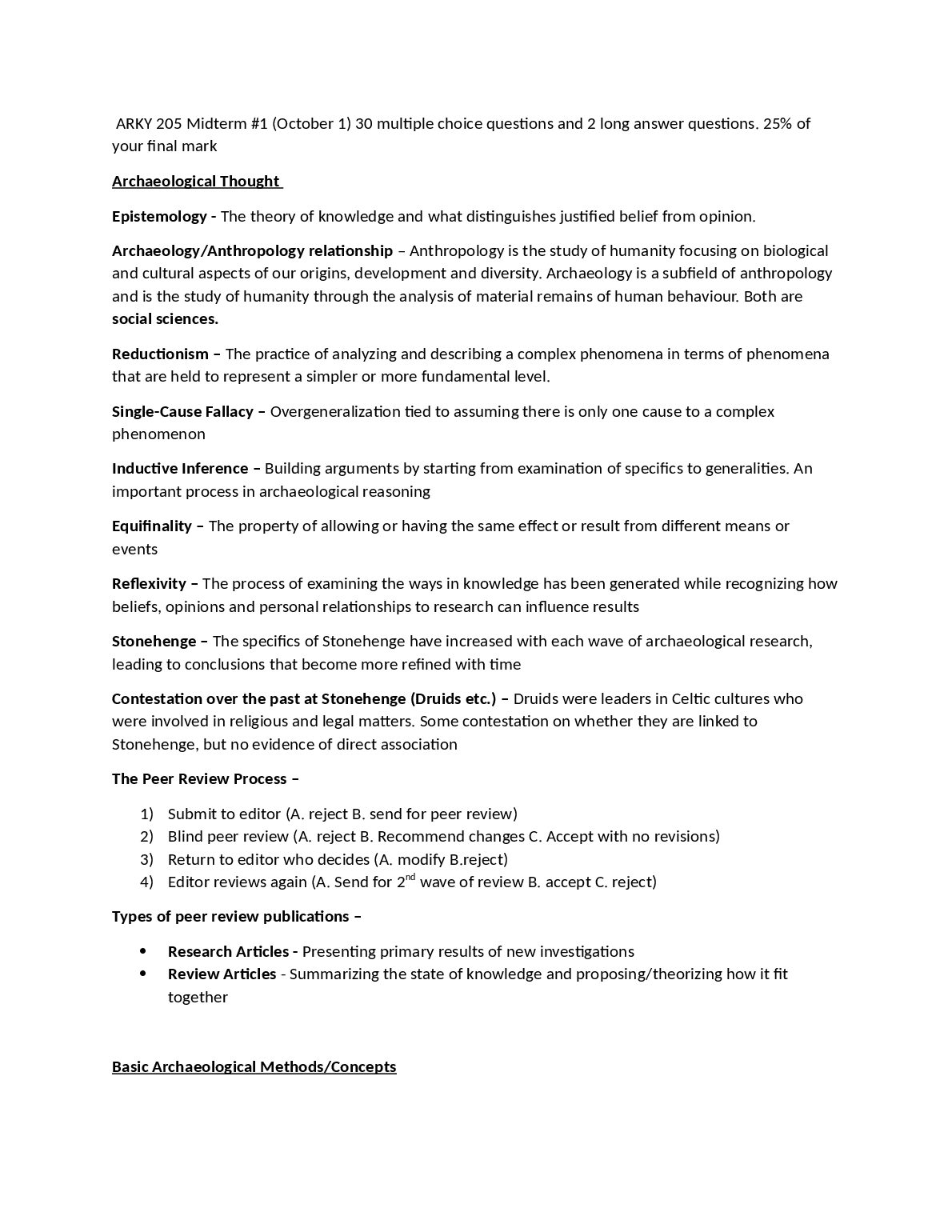
ARKY 205 Midterm #1 (October 1) 30 multiple choice questions and 2 long answer questions. 25% of
your final mark
Archaeological Thought
Epistemology - The theory of knowledge and what distinguishes justified belief from opinion.
Archaeology/Anthropology relationship – Anthropology is the study of humanity focusing on biological
...[Show More]
ARKY 205 Midterm #1 (October 1) 30 multiple choice questions and 2 long answer questions. 25% of
your final mark
Archaeological Thought
Epistemology - The theory of knowledge and what distinguishes justified belief from opinion.
Archaeology/Anthropology relationship – Anthropology is the study of humanity focusing on biological
and cultural aspects of our origins, development and diversity. Archaeology is a subfield of anthropology
and is the study of humanity through the analysis of material remains of human behaviour. Both are
social sciences.
Reductionism – The practice of analyzing and describing a complex phenomena in terms of phenomena
that are held to represent a simpler or more fundamental level.
Single-Cause Fallacy – Overgeneralization tied to assuming there is only one cause to a complex
phenomenon
Inductive Inference – Building arguments by starting from examination of specifics to generalities. An
important process in archaeological reasoning
Equifinality – The property of allowing or having the same effect or result from different means or
events
Reflexivity – The process of examining the ways in knowledge has been generated while recognizing how
beliefs, opinions and personal relationships to research can influence results
Stonehenge – The specifics of Stonehenge have increased with each wave of archaeological research,
leading to conclusions that become more refined with time
Contestation over the past at Stonehenge (Druids etc.) – Druids were leaders in Celtic cultures who
were involved in religious and legal matters. Some contestation on whether they are linked to
Stonehenge, but no evidence of direct association
The Peer Review Process –
1) Submit to editor (A. reject B. send for peer review)
2) Blind peer review (A. reject B. Recommend changes C. Accept with no revisions)
3) Return to editor who decides (A. modify B.reject)
4) Editor reviews again (A. Send for 2nd wave of review B. accept C. reject)
Types of peer review publications –
· Research Articles - Presenting primary results of new investigations
· Review Articles - Summarizing the state of knowledge and proposing/theorizing how it fit
together
Basic Archaeological Methods/Concepts
[Show Less]