DEPARTMENT OF ECONOMICS & QUANTITATIVE FINANCE ECON-202 • Academic Year 2024-2025
Macroeconomics & Financial Systems: Comprehensive Examination
Review & Study Guide [Comprehensive Study Guide & Solutions]
Module Focus: National Income Accounting, GDP Metrics & Price Deflators | Total Items: 15 | Academic Term: Academic Year 2024-2025
UNIT CONCEPTUAL OVERVIEW & STUDY OBJECTIVES:
Th
...[Show More]
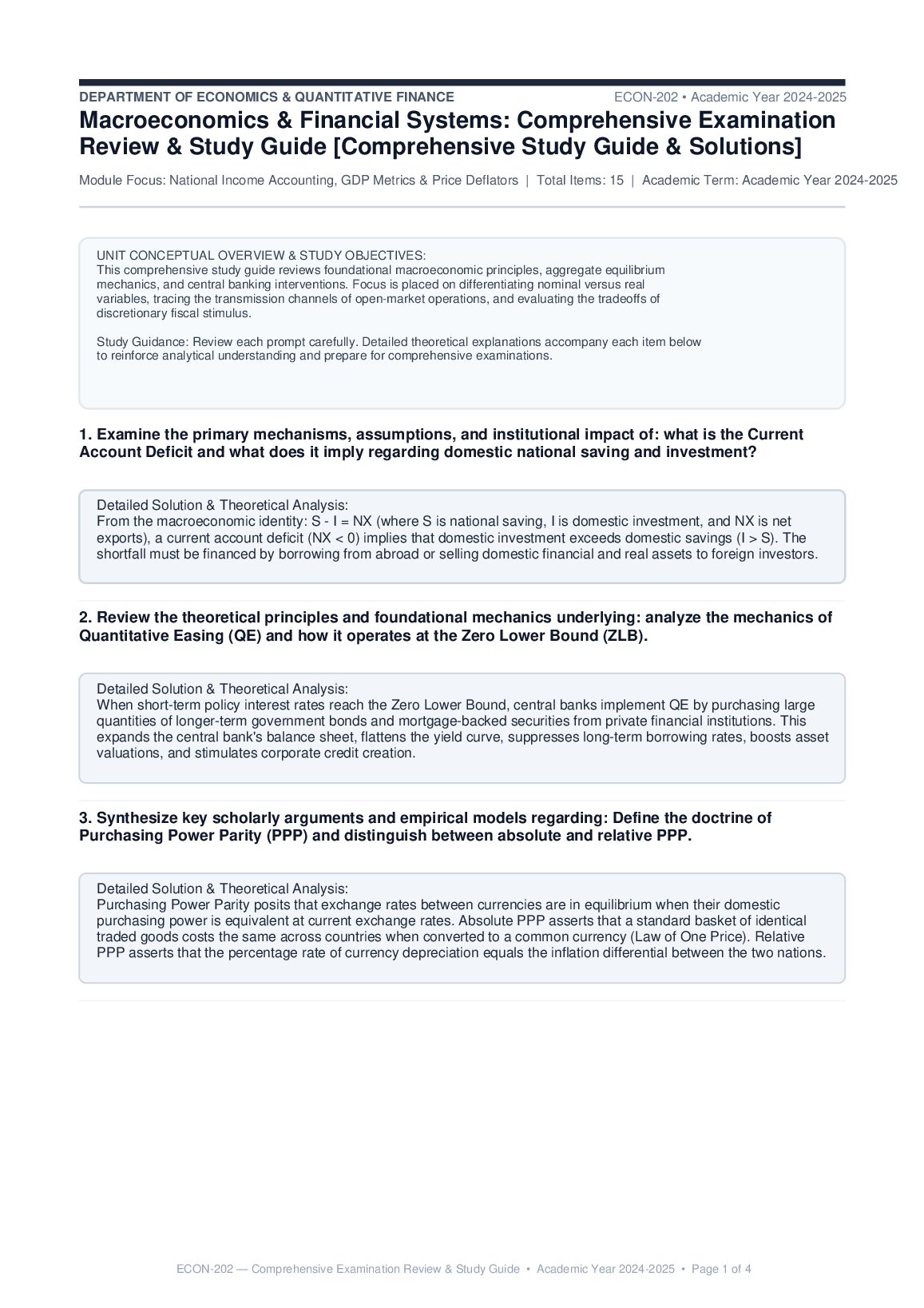
DEPARTMENT OF ECONOMICS & QUANTITATIVE FINANCE ECON-202 • Academic Year 2024-2025
Macroeconomics & Financial Systems: Comprehensive Examination
Review & Study Guide [Comprehensive Study Guide & Solutions]
Module Focus: National Income Accounting, GDP Metrics & Price Deflators | Total Items: 15 | Academic Term: Academic Year 2024-2025
UNIT CONCEPTUAL OVERVIEW & STUDY OBJECTIVES:
This comprehensive study guide reviews foundational macroeconomic principles, aggregate equilibrium
mechanics, and central banking interventions. Focus is placed on differentiating nominal versus real
variables, tracing the transmission channels of open-market operations, and evaluating the tradeoffs of
discretionary fiscal stimulus.
Study Guidance: Review each prompt carefully. Detailed theoretical explanations accompany each item below
to reinforce analytical understanding and prepare for comprehensive examinations.
1. Examine the primary mechanisms, assumptions, and institutional impact of: what is the Current
Account Deficit and what does it imply regarding domestic national saving and investment?
Detailed Solution & Theoretical Analysis:
From the macroeconomic identity: S - I = NX (where S is national saving, I is domestic investment, and NX is net
exports), a current account deficit (NX < 0) implies that domestic investment exceeds domestic savings (I > S). The
shortfall must be financed by borrowing from abroad or selling domestic financial and real assets to foreign investors.
2. Review the theoretical principles and foundational mechanics underlying: analyze the mechanics of
Quantitative Easing (QE) and how it operates at the Zero Lower Bound (ZLB).
Detailed Solution & Theoretical Analysis:
When short-term policy interest rates reach the Zero Lower Bound, central banks implement QE by purchasing large
quantities of longer-term government bonds and mortgage-backed securities from private financial institutions. This
expands the central bank's balance sheet, flattens the yield curve, suppresses long-term borrowing rates, boosts asset
valuations, and stimulates corporate credit creation.
3. Synthesize key scholarly arguments and empirical models regarding: Define the doctrine of
Purchasing Power Parity (PPP) and distinguish between absolute and relative PPP.
Detailed Solution & Theoretical Analysis:
Purchasing Power Parity posits that exchange rates between currencies are in equilibrium when their domestic
purchasing power is equivalent at current exchange rates. Absolute PPP asserts that a standard basket of identical
traded goods costs the same across countries when converted to a common currency (Law of One Price). Relative
PPP asserts that the percentage rate of currency depreciation equals the inflation differential between the two nations.
[Show Less]