DEPARTMENT OF PSYCHOLOGICAL SCIENCES & NEUROCOGNITION PSY-101 • Academic Year 2024-2025
Psychology & Behavioral Science: Final Exam Preparation Packet
[Comprehensive Study Guide & Solutions]
Module Focus: Neurobiological Foundations & Brain Architecture | Total Items: 15 | Academic Term: Academic Year 2024-2025
UNIT CONCEPTUAL OVERVIEW & STUDY OBJECTIVES:
This review packet synthe
...[Show More]
DEPARTMENT OF PSYCHOLOGICAL SCIENCES & NEUROCOGNITION PSY-101 • Academic Year 2024-2025
Psychology & Behavioral Science: Final Exam Preparation Packet
[Comprehensive Study Guide & Solutions]
Module Focus: Neurobiological Foundations & Brain Architecture | Total Items: 15 | Academic Term: Academic Year 2024-2025
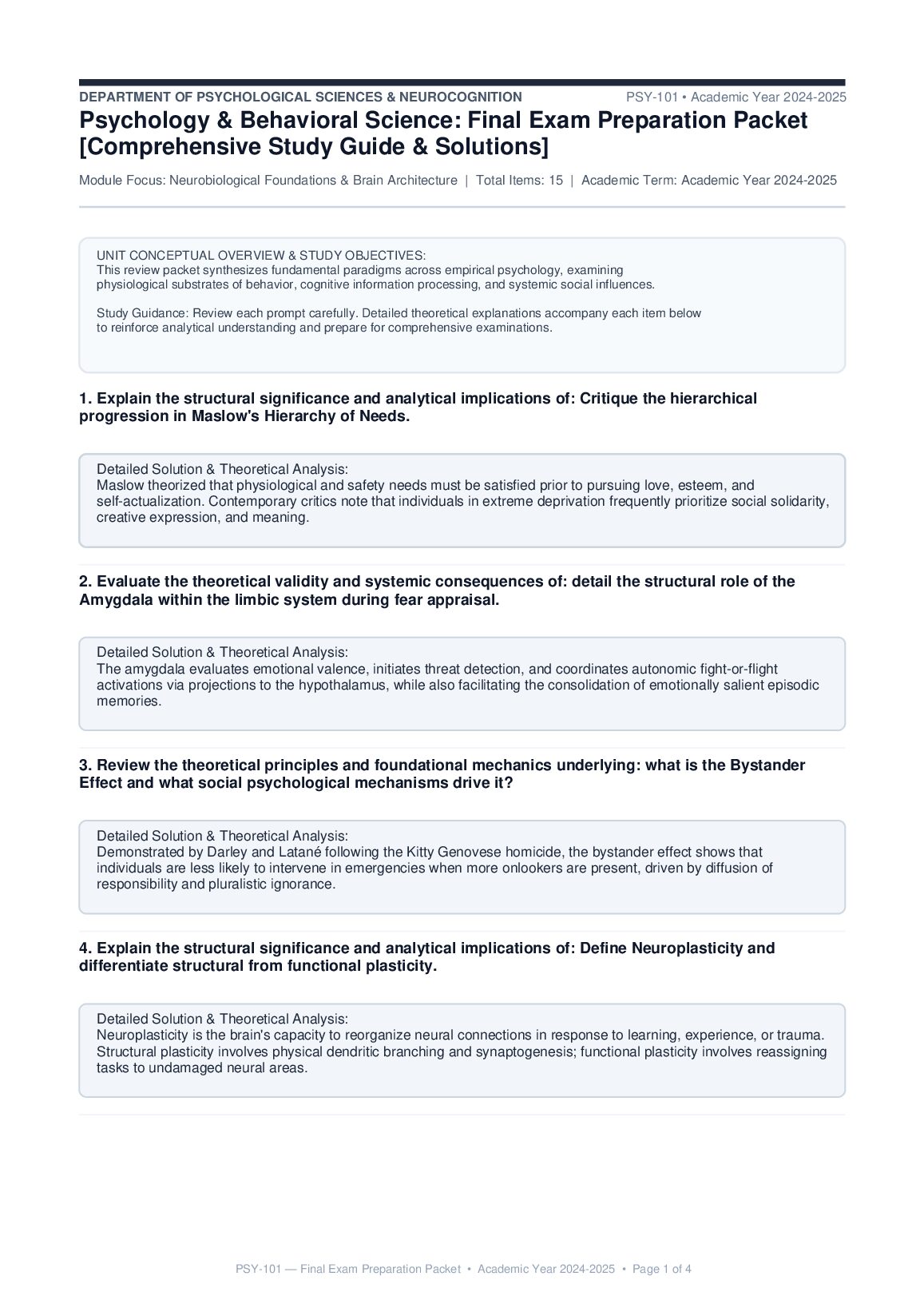
UNIT CONCEPTUAL OVERVIEW & STUDY OBJECTIVES:
This review packet synthesizes fundamental paradigms across empirical psychology, examining
physiological substrates of behavior, cognitive information processing, and systemic social influences.
Study Guidance: Review each prompt carefully. Detailed theoretical explanations accompany each item below
to reinforce analytical understanding and prepare for comprehensive examinations.
1. Explain the structural significance and analytical implications of: Critique the hierarchical
progression in Maslow's Hierarchy of Needs.
Detailed Solution & Theoretical Analysis:
Maslow theorized that physiological and safety needs must be satisfied prior to pursuing love, esteem, and
self-actualization. Contemporary critics note that individuals in extreme deprivation frequently prioritize social solidarity,
creative expression, and meaning.
2. Evaluate the theoretical validity and systemic consequences of: detail the structural role of the
Amygdala within the limbic system during fear appraisal.
Detailed Solution & Theoretical Analysis:
The amygdala evaluates emotional valence, initiates threat detection, and coordinates autonomic fight-or-flight
activations via projections to the hypothalamus, while also facilitating the consolidation of emotionally salient episodic
memories.
3. Review the theoretical principles and foundational mechanics underlying: what is the Bystander
Effect and what social psychological mechanisms drive it?
Detailed Solution & Theoretical Analysis:
Demonstrated by Darley and Latané following the Kitty Genovese homicide, the bystander effect shows that
individuals are less likely to intervene in emergencies when more onlookers are present, driven by diffusion of
responsibility and pluralistic ignorance.
4. Explain the structural significance and analytical implications of: Define Neuroplasticity and
differentiate structural from functional plasticity.
Detailed Solution & Theoretical Analysis:
Neuroplasticity is the brain's capacity to reorganize neural connections in response to learning, experience, or trauma.
Structural plasticity involves physical dendritic branching and synaptogenesis; functional plasticity involves reassigning
tasks to undamaged neural areas.
[Show Less]