DEPARTMENT OF CHEMISTRY & MOLECULAR PHARMACOLOGY CHEM-201 • Academic Year 2024-2025
Organic Chemistry & Molecular Reactions: Departmental Practice
Examination [Comprehensive Study Guide & Solutions]
Module Focus: Aromaticity, Huckel's Rule & Electrophilic Aromatic Substitution (EAS) | Total Items: 15 | Academic Term: Academic Year 2024-
UNIT CONCEPTUAL OVERVIEW & STUDY OBJECTIVES:
...[Show More]
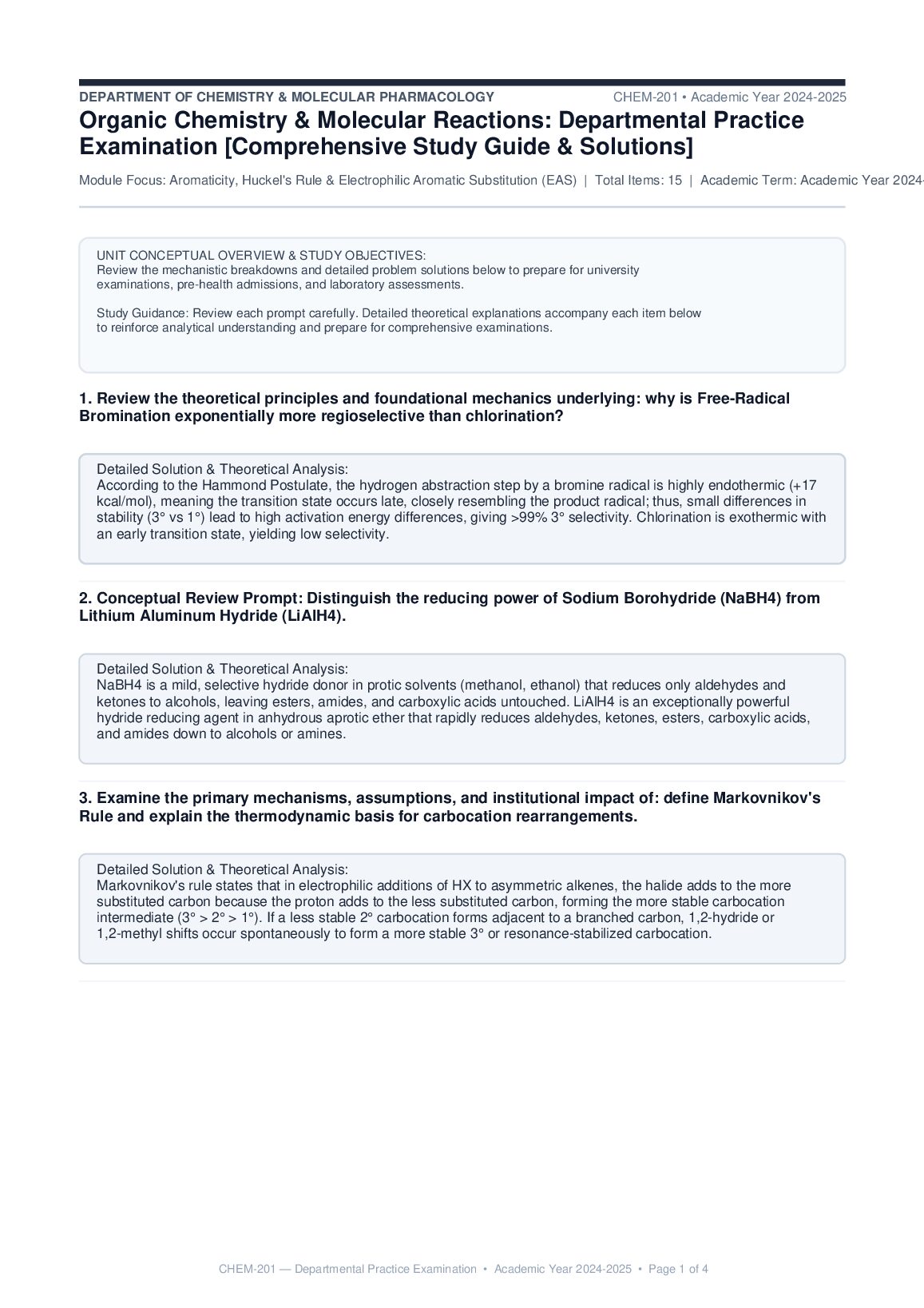
DEPARTMENT OF CHEMISTRY & MOLECULAR PHARMACOLOGY CHEM-201 • Academic Year 2024-2025
Organic Chemistry & Molecular Reactions: Departmental Practice
Examination [Comprehensive Study Guide & Solutions]
Module Focus: Aromaticity, Huckel's Rule & Electrophilic Aromatic Substitution (EAS) | Total Items: 15 | Academic Term: Academic Year 2024-
UNIT CONCEPTUAL OVERVIEW & STUDY OBJECTIVES:
Review the mechanistic breakdowns and detailed problem solutions below to prepare for university
examinations, pre-health admissions, and laboratory assessments.
Study Guidance: Review each prompt carefully. Detailed theoretical explanations accompany each item below
to reinforce analytical understanding and prepare for comprehensive examinations.
1. Review the theoretical principles and foundational mechanics underlying: why is Free-Radical
Bromination exponentially more regioselective than chlorination?
Detailed Solution & Theoretical Analysis:
According to the Hammond Postulate, the hydrogen abstraction step by a bromine radical is highly endothermic (+17
kcal/mol), meaning the transition state occurs late, closely resembling the product radical; thus, small differences in
stability (3° vs 1°) lead to high activation energy differences, giving >99% 3° selectivity. Chlorination is exothermic with
an early transition state, yielding low selectivity.
2. Conceptual Review Prompt: Distinguish the reducing power of Sodium Borohydride (NaBH4) from
Lithium Aluminum Hydride (LiAlH4).
Detailed Solution & Theoretical Analysis:
NaBH4 is a mild, selective hydride donor in protic solvents (methanol, ethanol) that reduces only aldehydes and
ketones to alcohols, leaving esters, amides, and carboxylic acids untouched. LiAlH4 is an exceptionally powerful
hydride reducing agent in anhydrous aprotic ether that rapidly reduces aldehydes, ketones, esters, carboxylic acids,
and amides down to alcohols or amines.
3. Examine the primary mechanisms, assumptions, and institutional impact of: define Markovnikov's
Rule and explain the thermodynamic basis for carbocation rearrangements.
Detailed Solution & Theoretical Analysis:
Markovnikov's rule states that in electrophilic additions of HX to asymmetric alkenes, the halide adds to the more
substituted carbon because the proton adds to the less substituted carbon, forming the more stable carbocation
intermediate (3° > 2° > 1°). If a less stable 2° carbocation forms adjacent to a branched carbon, 1,2-hydride or
1,2-methyl shifts occur spontaneously to form a more stable 3° or resonance-stabilized carbocation
[Show Less]