DEPARTMENT OF ECONOMICS & QUANTITATIVE FINANCE ECON-202 • Academic Year 2024-2025
Macroeconomics & Financial Systems: Core Concepts Workshop &
Practice Problems [Comprehensive Study Guide & Solutions]
Module Focus: Fiscal Policy, Sovereign Debt Sustainability & Crowding-Out Dynamics | Total Items: 15 | Academic Term: Academic Year 2024
UNIT CONCEPTUAL OVERVIEW & STUDY OBJECTIVES:
...[Show More]
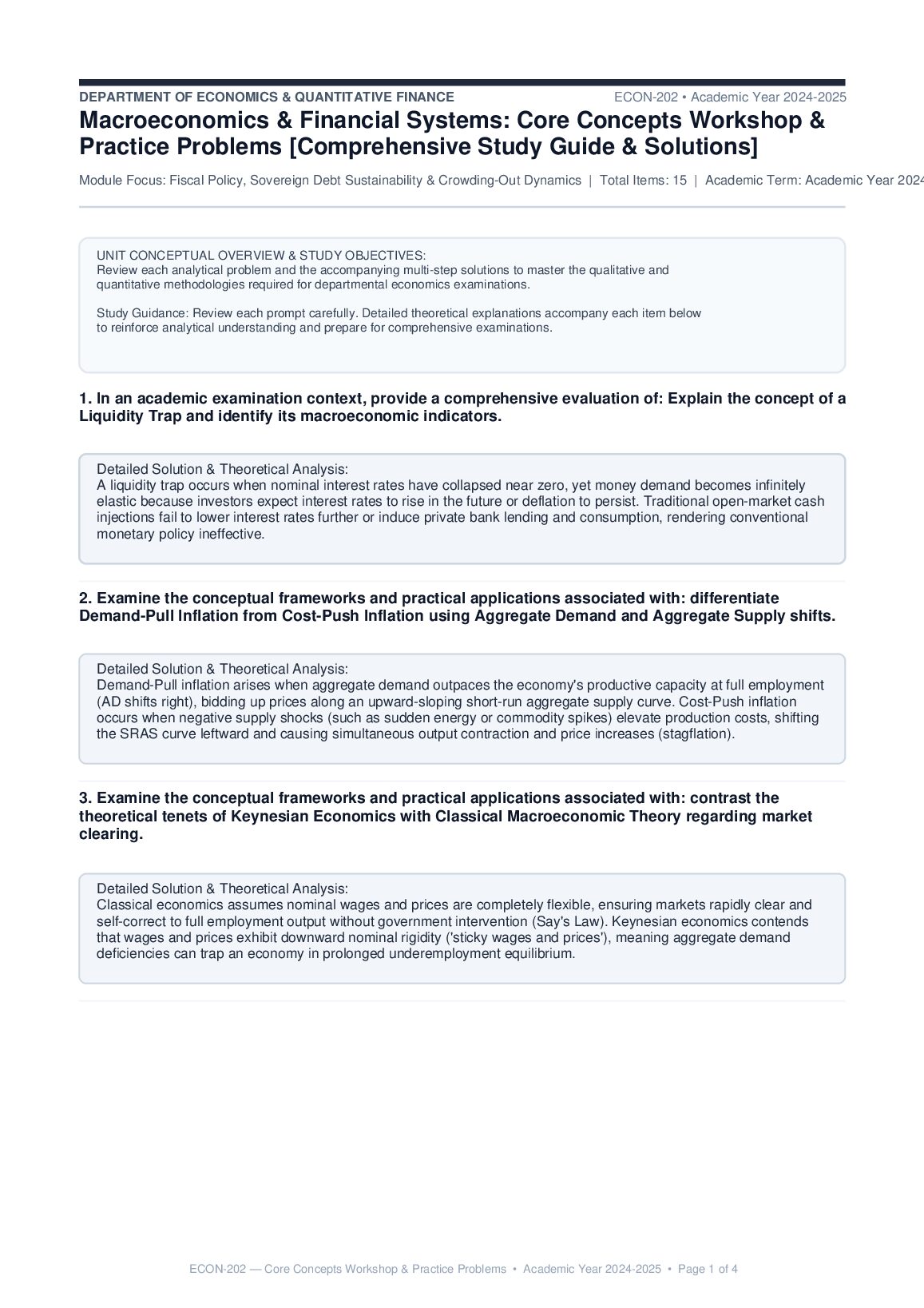
DEPARTMENT OF ECONOMICS & QUANTITATIVE FINANCE ECON-202 • Academic Year 2024-2025
Macroeconomics & Financial Systems: Core Concepts Workshop &
Practice Problems [Comprehensive Study Guide & Solutions]
Module Focus: Fiscal Policy, Sovereign Debt Sustainability & Crowding-Out Dynamics | Total Items: 15 | Academic Term: Academic Year 2024
UNIT CONCEPTUAL OVERVIEW & STUDY OBJECTIVES:
Review each analytical problem and the accompanying multi-step solutions to master the qualitative and
quantitative methodologies required for departmental economics examinations.
Study Guidance: Review each prompt carefully. Detailed theoretical explanations accompany each item below
to reinforce analytical understanding and prepare for comprehensive examinations.
1. In an academic examination context, provide a comprehensive evaluation of: Explain the concept of a
Liquidity Trap and identify its macroeconomic indicators.
Detailed Solution & Theoretical Analysis:
A liquidity trap occurs when nominal interest rates have collapsed near zero, yet money demand becomes infinitely
elastic because investors expect interest rates to rise in the future or deflation to persist. Traditional open-market cash
injections fail to lower interest rates further or induce private bank lending and consumption, rendering conventional
monetary policy ineffective.
2. Examine the conceptual frameworks and practical applications associated with: differentiate
Demand-Pull Inflation from Cost-Push Inflation using Aggregate Demand and Aggregate Supply shifts.
Detailed Solution & Theoretical Analysis:
Demand-Pull inflation arises when aggregate demand outpaces the economy's productive capacity at full employment
(AD shifts right), bidding up prices along an upward-sloping short-run aggregate supply curve. Cost-Push inflation
occurs when negative supply shocks (such as sudden energy or commodity spikes) elevate production costs, shifting
the SRAS curve leftward and causing simultaneous output contraction and price increases (stagflation).
3. Examine the conceptual frameworks and practical applications associated with: contrast the
theoretical tenets of Keynesian Economics with Classical Macroeconomic Theory regarding market
clearing.
Detailed Solution & Theoretical Analysis:
Classical economics assumes nominal wages and prices are completely flexible, ensuring markets rapidly clear and
self-correct to full employment output without government intervention (Say's Law). Keynesian economics contends
that wages and prices exhibit downward nominal rigidity ('sticky wages and prices'), meaning aggregate demand
deficiencies can trap an economy in prolonged underemployment equilibrium
[Show Less]