UCLA Community School-Los Angeles
AEROSPACE ENGINEERING 161A
SCIN261 INTRODUCTION TO PLANETARY SCIENCE Lab 1: Planetary Orbits INTRODUCTION The Scientific Observation is the key tool of a scientist. It helps a researcher to identify promising aspects of natural phenomena, formulate the right questions and search for answers. Inference is a logical explanation or conclusion ba
...[Show More]
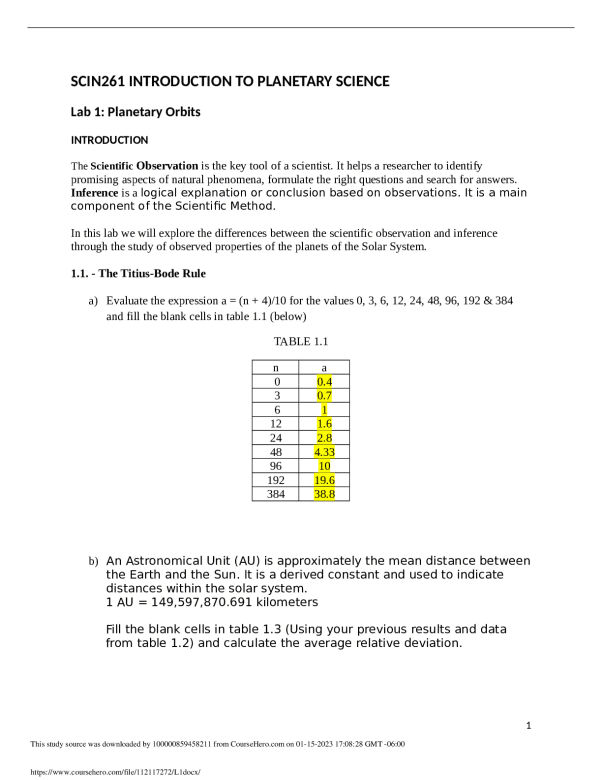
SCIN261 INTRODUCTION TO PLANETARY SCIENCE Lab 1: Planetary Orbits INTRODUCTION The Scientific Observation is the key tool of a scientist. It helps a researcher to identify promising aspects of natural phenomena, formulate the right questions and search for answers. Inference is a logical explanation or conclusion based on observations. It is a main component of the Scientific Method. In this lab we will explore the differences between the scientific observation and inference through the study of observed properties of the planets of the Solar System. 1.1. - The Titius-Bode Rule a) Evaluate the expression a = (n + 4)/10 for the values 0, 3, 6, 12, 24, 48, 96, 192 & 384 and fill the blank cells in table 1.1 (below) TABLE 1.1 n a 0 0.4 3 0.7 6 1 12 1.6 24 2.8 48 4.33 96 10 192 19.6 384 38.8 b) An Astronomical Unit (AU) is approximately the mean distance between the Earth and the Sun. It is a derived constant and used to indicate distances within the solar system. 1 AU = 149,597,870.691 kilometers Fill the blank cells in table 1.3 (Using your previous results and data from table 1.2) and calculate the ave
[Show Less]
![MGT 301 Business Strategy Chapter_Review Study Sheet_ Comprehensive Study Guide & Solutions] preview image](https://browseimages.nyc3.digitaloceanspaces.com/unlock-images/2026/Oct/14/paper-104210-preview-1-NfnUEH.jpg)