Keiser University
LIFE SPAN 145
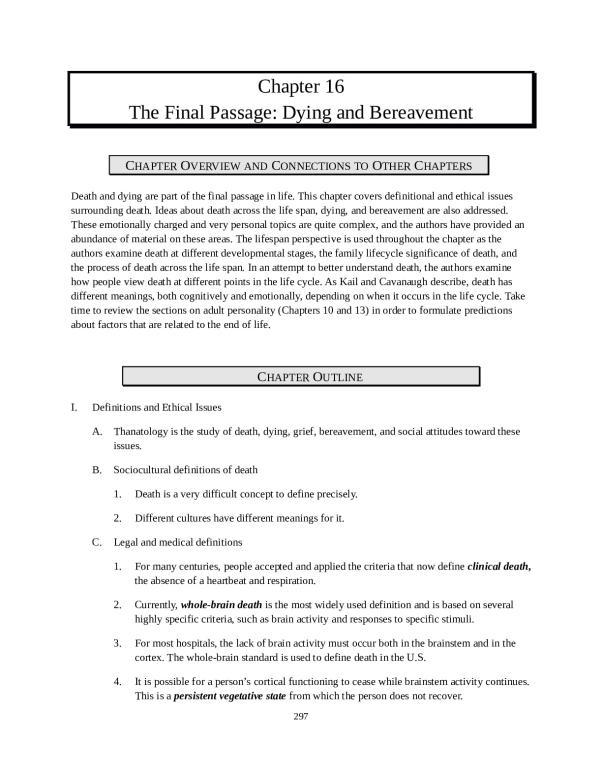
Chapter 16 The Final Passage: Dying and Bereavement CHAPTER OVERVIEW AND CONNECTIONS TO OTHER CHAPTERS Death and dying are part of the final passage in life. This chapter covers definitional and ethical issues surrounding death. Ideas about death across the life span, dying, and bereavement are also addressed. These emotionally charged and ve
...[Show More]
Chapter 16 The Final Passage: Dying and Bereavement CHAPTER OVERVIEW AND CONNECTIONS TO OTHER CHAPTERS Death and dying are part of the final passage in life. This chapter covers definitional and ethical issues surrounding death. Ideas about death across the life span, dying, and bereavement are also addressed. These emotionally charged and very personal topics are quite complex, and the authors have provided an abundance of material on these areas. The lifespan perspective is used throughout the chapter as the authors examine death at different developmental stages, the family lifecycle significance of death, and the process of death across the life span. In an attempt to better understand death, the authors examine how people view death at different points in the life cycle. As Kail and Cavanaugh describe, death has different meanings, both cognitively and emotionally, depending on when it occurs in the life cycle. Take time to review the sections on adult personality (Chapters 10 and 13) in order to formulate predictions about factors that are related to the end of life. CHAPTER OUTLINE I. Definitions and Ethical Issues A. Thanatology is the study of death, dying, grief, bereavement, and social attitudes toward these issues. B. Sociocultural definitions of death 1. Death is a very difficult concept to define precisely. 2. Different cultures have different meanings for it. C. Legal and medical definitions 1. For many centuries, people accepted and applied the criteria that now define clinical death, the absence of a heartbeat and respiration. 2. Currently, whole-brain death is the most widely used definition and is based on several highly specific criteria, such as brain activity and responses to specific stimuli. 3. For most hospitals, the lack of brain activity must occur both in the brainstem and in the cortex. The whole-brain standard is used to define death in the U.S. 4. It is possible for a person’s cortical functioning to cease while brainstem activity continues. This is a persistent vegetative state from which the person does not recover. 297 Chapter 16 a) This state allows for spontaneous heartbeat and respiration, but not for consciousness. b) The whole-brain standard does not permit a declaration of death for someone who is in a persistent vegetative state. D. Ethical issues 1. Bioethics is the study of the interface between human values and technological advances in health and life sciences. a) It grew from two bases: (1) Respect for individual freedom (2) The impossibility of establishing any single version of morality by rational argument or common sense 2. In the area of death and dying, the most important bioethical issue is euthanasia – the practice of ending life for reasons of mercy. a) Two types of euthanasia are distinguished: (1) Active euthanasia means d
[Show Less]